

What Is Breast Augmentation?
Breast augmentation (augmentation mammaplasty) enlarges and reshapes the breasts with implants. It is chosen by women who want more fullness, who have lost volume after pregnancy, breastfeeding or weight loss, whose breasts are uneven, or who simply want a more proportional figure. It is the most frequently performed cosmetic surgery in the United States, and the one board-certified plastic surgeon Dr. Moises Salama has performed thousands of times over more than two decades at Elite Plastic Surgery in Hollywood, serving Miami. The result depends on four decisions, implant type, size, placement and incision, and this page explains each so you arrive at your consultation knowing the questions to ask.
Breast augmentation at a glance
- Implants
- Silicone gel, saline and form-stable gel; Natrelle® and Motiva® (Motiva® preferred); Preservé™ technique available
- Placement
- Dual plane (partly under the muscle) for most patients
- Incisions
- Inframammary (fold), periareolar or transaxillary
- Anesthesia / time
- General; about 1 hour; home the same day
- Recovery
- Desk work ~1 week; exercise 6 weeks; implants settled ~3 months
- Cost in Miami
- $6,000–$11,000 in total, implants included; Motiva® from $6,999
- Not offered
- Fat transfer to the breast
- Surgeon
- Dr. Moises Salama, thousands of breast augmentations
Breast Implant Types: Choosing the Right Option
| Implant | How it feels and looks | Best for | Notes |
|---|---|---|---|
| Silicone gel | Closest to natural breast tissue; soft, with a natural slope | Most patients, especially those with less breast tissue | Pre-filled; slightly longer incision; periodic ultrasound or MRI screening recommended by the FDA |
| Saline | Firmer; rounder upper pole; rippling more visible in thin patients | Patients who prefer saltwater fill, a smaller incision or a lower price | Filled during surgery, so volume can be fine-tuned; a leak deflates visibly and harmlessly |
| Form-stable (“gummy bear”) | Firmer, holds its shape; round or teardrop | Thin patients, reconstruction, shape control | Teardrop shapes used selectively because they can rotate |
| Motiva® | Soft, smooth-surfaced silicone gel implants that move naturally | Patients who want the softest feel and the Preservé™ minimal-disruption technique | Motiva® page · Preservé™ page |
| Natrelle® | Full range of gel cohesivities and profiles | Patients who want a specific profile or projection | Natrelle® page |
Dr. Salama does not perform fat transfer to the breast. Patients looking for a subtle, natural increase are usually best served by a smaller implant placed in the dual plane. For patients with existing implants who want a change, see breast implant exchange.
Video: Dr. Salama compares saline and silicone breast implants.
Choosing Your Implant Size and Profile
Size is the decision patients worry about most, and the one that measurement makes simple. Dr. Salama measures the width of your breast base, the thickness of your tissue and the position of your nipple and fold. Those numbers set the range of implant widths that fit your chest; an implant wider than your breast footprint looks unnatural and can drift outward or toward the middle. Within that width, the profile (moderate, high or extra-high) sets how much the implant projects, and the volume in cc sets the size. One cup size is roughly 125 to 150 cc. At the consultation you try sizers in a bra, look at gallery cases with your measurements, and settle on a range; Dr. Salama confirms the final choice in the operating room with sizers if needed.
Medical illustrations, simplified and not to scale.
Video: Dr. Salama on choosing breast implant size.
Implant Placement: Dual Plane vs. Over the Muscle
- Dual plane (Dr. Salama’s usual choice). The upper part of the implant sits under the pectoralis muscle and the lower part under the breast tissue. The muscle smooths the upper edge and hides rippling, the contracture rate is lower, and the lower breast fills naturally. Recovery is slightly tighter in the first week.
- Over the muscle (subglandular). The implant sits under the gland only. Faster, less sore recovery and no movement of the implant with the chest muscle, but it needs enough tissue to cover the implant and has a higher contracture rate; used for selected patients.
Breast Augmentation Incision Options
- Inframammary. In the crease under the breast. The most common choice: the best access and control for placing the implant, no contact with the ducts, and a scar hidden in the fold.
- Periareolar. Along the lower edge of the areola, where the scar blends into the color change. Suits patients with a larger areola; slightly higher chance of affecting nipple sensation or breastfeeding.
- Transaxillary. In the armpit, leaving no scar on the breast. Suits saline and smaller gel implants; placement is done with an endoscope.
Dr. Salama recommends the incision at your consultation based on your anatomy, the implant you choose and your goals; most patients have the inframammary incision.
The Breast Augmentation Procedure
- Consultation. Measurements, sizers, a review of gallery cases with your frame, and a plan for implant type, size, placement and incision. A virtual consultation with photos is available for out-of-town patients.
- Before surgery. Labs and, when needed, medical clearance; no nicotine for a month before and after; stop blood-thinning supplements two weeks before.
- Anesthesia. General anesthesia by a board-certified anesthesia provider in the practice’s state-certified surgical facility.
- Surgery. About an hour. The pocket is created in the planned plane, irrigated with antibiotic solution, and the implant is placed with a no-touch technique; the incision is closed in layers with dissolving sutures.
- Same-day discharge in a surgical bra, with written instructions and a follow-up visit in the first days.
Breast Augmentation Results
Dr. Salama’s gallery holds dozens of breast augmentation cases with the implant size and type listed for each, so you can see what a given volume looks like on a frame like yours.


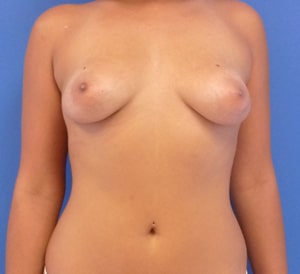
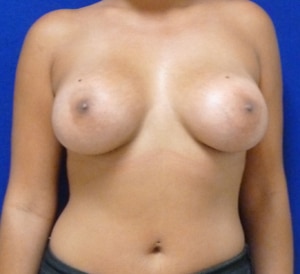


See all breast augmentation cases →
Video: A patient describes her breast augmentation experience with Dr. Salama.
Who Is a Good Candidate?
- You want fuller, more proportional or more even breasts, or to restore volume lost after pregnancy or weight loss.
- Your breast development is complete (18 or older for saline, 22 for silicone under FDA labeling).
- You are in good health, at a stable weight, and do not smoke or will stop for a month before and after surgery.
- Your nipples sit at or above the breast fold; if they have dropped, a breast lift with implants gives a better result than an implant alone.
- Your breasts are constricted or tube-shaped: see tuberous breast correction, which needs more than a standard augmentation.
Recovery After Breast Augmentation
| Time after surgery | What to expect |
|---|---|
| Days 1–3 | Tightness and soreness; implants sit high. Walk every hour while awake. Surgical bra day and night. Sleep on your back, elevated. |
| Days 4–7 | Off prescription pain medication for most; drive once you are. Shower from 48 hours. |
| Weeks 1–2 | Desk work. No reaching or upper-arm movement. Massage begins if Dr. Salama recommends it for your implant. |
| Weeks 3–6 | Swelling falls; light lower-body cardio. Nothing over 5 lb until week 6. |
| Week 6 | Cleared for exercise and regular bras; implants begin to settle (“drop and fluff”). |
| Month 3 | Implants settled; final shape; bra fitting. |
The complete plan, including sleeping, massage, scar care and what is normal versus what to call about, is in the breast augmentation recovery guide.
Video: Dr. Salama’s recovery tips after breast augmentation.
Risks and How They’re Managed
Capsular contracture (a tightened scar capsule; reduced by dual-plane placement, antibiotic irrigation and no-touch insertion, and treated with total capsulectomy if it occurs), implant rupture (saline deflates visibly; silicone is screened by ultrasound or MRI), infection and bleeding (sterile technique, drains when needed), changes in nipple sensation (usually temporary), asymmetry or malposition (measured planning; pocket repair if needed, including symmastia repair), rippling (dual plane, gel implants, right-sized width), and the likelihood of another breast surgery at some point in your life, because implants are not lifetime devices. Dr. Salama reviews each with you at the consultation.
How Much Does Breast Augmentation Cost in Miami?
Breast augmentation in Miami typically costs between $6,000 and $11,000 in total, implants included. Saline implants sit at the lower end, silicone gel implants in the middle, and premium options such as Motiva® and the Preservé™ technique at the higher end. Nationally, the surgeon’s fee alone averages $4,575 to $8,000, according to the American Society of Plastic Surgeons.
What your breast augmentation quote includes
Your written quote from Elite Plastic Surgery lists the surgeon’s fee, the anesthesia fee, your implants and your post-operative care. For Motiva® and Preservé™, see the pricing on the Motiva® and Preservé™ pages; Motiva® augmentation starts from $6,999.
What changes the price of breast augmentation
- Implant type. Saline costs less than silicone gel; form-stable and premium implants cost more.
- Implant brand. Natrelle® and Motiva® implants are priced differently.
- Technique. Placement above or below the muscle, and approaches like Preservé™, change surgical time.
- Adding a lift. Sagging breasts may need a lift with the implants, which costs more (see breast lift with implants).
- Replacing older implants. An implant exchange or removal is priced separately from a first augmentation.
Are breast implants included in the cost of a boob job?
At Elite Plastic Surgery, yes. Your quote includes the implants. Some advertised prices leave out the implants or the anesthesia, so check what any quote covers.
Why are silicone implants more expensive than saline?
Silicone gel implants cost more to manufacture and feel closer to natural breast tissue. Saline implants are filled during surgery and cost less, but some patients find them less natural to the touch. Financing is available through CareCredit, United Medical Credit and Alphaeon Credit; see financing.
Why Choose Dr. Salama for Breast Augmentation in Miami
Patient reviews: 4.9★ on Google, 748 reviews for Elite Plastic Surgery · 4.7★ on RealSelf, 2,561 reviews (RealSelf Verified) · counts as of October 2026.
- Certified by the American Board of Plastic Surgery and the American Board of Surgery; member of the American Society of Plastic Surgeons and The Aesthetic Society.
- Surgery in the practice’s own state-certified facility in Hollywood, Florida, minutes from Miami, with board-certified anesthesia providers.
- Measurement-based sizing, gallery cases listed with implant volume, and an honest recommendation about implants versus a lift.
- Bilingual team: hablamos español. Virtual consultations for out-of-town patients.
Ready to Talk Size, Type and Placement?
Book a virtual consultation from home, or call or text (305) 933-4033. Hablamos español.
Breast Augmentation Frequently Asked Questions
How much does breast augmentation cost in Miami?
Breast augmentation in Miami typically costs between $6,000 and $11,000 in total, implants included. Your written quote from Elite Plastic Surgery lists the surgeon’s fee, the anesthesia fee, your implants and your post-operative care, and financing through CareCredit, United Medical Credit and Alphaeon Credit is available. Motiva® augmentation starts from $6,999.
What type of breast implants do you recommend?
Dr. Salama offers silicone gel, saline and form-stable (“gummy bear”) implants from Natrelle® and Motiva®, and prefers Motiva®. Silicone gel feels closest to natural breast tissue and is the most common choice; saline costs less and uses a smaller incision; form-stable gel holds its shape in thin patients. He recommends the type at your consultation based on your tissue, goals and budget.
How do I choose the right breast implant size?
By measurement, not by cup size alone. Dr. Salama measures the width of your breast base and the tissue available, which sets the range of implant widths that fit your chest; within that range, the volume and profile set how full and how projected the result is. As a rule of thumb, one cup size is about 125 to 150 cc. Bring photos of the look you want and the bra size you hope to wear.
Where is the implant placed: over or under the muscle?
Dr. Salama uses the dual-plane position for most patients: the upper part of the implant sits under the chest muscle, which smooths the upper edge, lowers rippling and reduces the risk of capsular contracture, while the lower part sits under the breast tissue, which lets the implant fill the lower breast naturally. Placement above the muscle is used for selected patients with enough tissue to cover the implant.
Which incision is best for breast augmentation?
Dr. Salama uses the inframammary incision, in the fold under the breast, for almost all of his augmentations, for three reasons: the scar hides in the crease, the incision does not pass through the milk ducts (which lowers the risk of capsular contracture compared with going through the areola), and it stays away from the sensory nerve to the nipple, so there is less chance of losing sensation. The periareolar incision can be done when a patient strongly prefers it, but it is not his first choice.
What is the recovery time after breast augmentation?
Most patients resume light activities within five to seven days and are back at desk work in about a week. Avoid reaching and upper-arm movement for one to two weeks and lifting over five pounds for six weeks; intense exercise resumes at six weeks. Complete recovery, with the implants settled, takes about three months. The week-by-week plan is in the breast augmentation recovery guide.
How long do I have to wait until I can exercise?
Walk from the day of surgery and every hour while awake. Intense exercise such as running, biking and lifting waits six weeks, because strain can disturb healing and shift the implants before the pocket has sealed.
When can I return to work after breast augmentation?
It depends on your job. Desk work in about a week; avoid reaching for one to two weeks and lifting anything over five pounds for six weeks, so physical jobs wait longer. Dr. Salama gives you a note with the restrictions that apply.
Will I be able to breastfeed after breast augmentation?
Yes, for most patients. Neither placement above nor under the muscle affects milk production, and the inframammary and transaxillary incisions do not disturb the ducts. The periareolar incision carries a somewhat higher risk of affecting breastfeeding; tell Dr. Salama if you plan to breastfeed so he can plan the incision accordingly.
Should I wait until I’m done having children?
Pregnancy changes the breasts whether or not you have implants, so a result can be affected by a later pregnancy. Many patients have augmentation before children and do well; if you plan a pregnancy within a year, Dr. Salama may suggest waiting. Breastfeeding with implants is safe.
What are the most popular breast implants?
Round, smooth silicone gel implants are the most common choice because they give fullness and lift, look natural in the dual plane and cannot rotate. Dr. Salama uses Natrelle® and Motiva® implants — Motiva® preferred — and the Preservé™ technique with Motiva® for patients who want the smallest possible tissue disruption.
How big should my breast implants be?
No wider than the base of your breast, which Dr. Salama measures at the consultation; an implant wider than your chest looks unnatural and can drift. Within the width that fits you, the profile (moderate, high or extra-high) sets the projection, and the volume sets the size. Patients in Dr. Salama’s gallery range from 240 cc to over 600 cc; each case lists the implant used.
Should I wear a bra after breast augmentation?
Yes: a surgical bra or a supportive sports bra without underwire, day and night for about six weeks, to support the implants and keep the incisions from rubbing. Underwires wait six to eight weeks. After six weeks you can go braless on occasion.
How long do breast implants last?
Implants are not lifetime devices, but the old advice to replace them every 10 years no longer applies. Dr. Salama’s approach with silicone implants is monitoring: an MRI starting around year five and roughly every three years after that — as long as the implant looks good and you have no symptoms, it does not need to be replaced. Saline implants simply deflate when they fail, which is obvious and covered by warranty if it happens in the first 10 years. Most patients replace implants once or twice in their lives, for size, shape or a complication. See breast implant exchange.
What are gummy bear implants?
Form-stable implants filled with a highly cohesive silicone gel that holds its shape even when the shell is cut, giving a firmer feel and a defined shape. They are available in round and teardrop (anatomic) shapes; teardrop implants are tapered at the top and fuller at the bottom and are used selectively because they can rotate.
Does Dr. Salama do fat transfer to the breast?
No. Dr. Salama does not perform fat transfer breast augmentation. Patients who want a modest, natural increase are usually well served by a smaller implant in the dual plane, and he will show you what that looks like for your frame.
How long do I have to stay in Miami for breast augmentation?
About five days for out-of-town patients: surgery, the first follow-up and enough time to be comfortable for the trip home. The rest of the follow-ups can be done by video with photos.
Is breast augmentation safe?
Breast augmentation is one of the most studied operations in plastic surgery and, performed by a board-certified plastic surgeon in an accredited facility, has a low complication rate. The risks, capsular contracture, implant rupture, infection, bleeding, changes in sensation, asymmetry and the need for future surgery, are explained at your consultation along with how each is reduced. Dr. Salama operates in the practice’s own state-certified facility with board-certified anesthesia providers.
Sources
- American Society of Plastic Surgeons, Breast augmentation and procedural statistics.
- U.S. Food and Drug Administration, Breast implants (labeling, age indications, screening recommendations).
- Elite Plastic Surgery breast augmentation gallery.