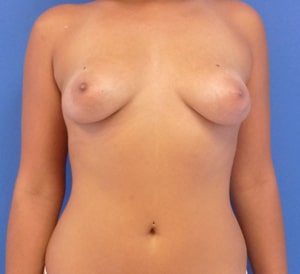
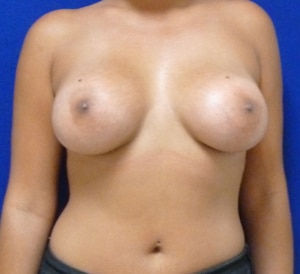
Medically reviewed by Moises Salama, MD, board-certified plastic surgeon · Last updated
What are Motiva® breast implants?
Motiva® implants are silicone gel breast implants made by Establishment Labs, a medical technology company headquartered in Costa Rica. The FDA approved them for breast augmentation in the United States on September 26, 2024. Establishment Labs describes it as the first new breast implant approval in the U.S. since 2013. Establishment Labs has delivered more than five million Motiva® devices to over 100 countries since 2010.
What sets Motiva® apart is how the implant is built. Instead of a textured shell, every Motiva® implant sold in the U.S. has the SmoothSilk® surface, a very smooth shell designed to cause less inflammation in the surrounding tissue. Inside is a soft, highly cohesive gel that holds its shape and moves with the body. The goal is a breast that looks natural standing, lying down and in motion, not one that looks “done.”
Dr. Salama was among the first board-certified plastic surgeons in South Florida to offer Motiva® implants. He chose them because their design matches what most of our patients ask for, a natural shape and soft feel, and because of their promising clinical data.
Motiva® at a glance
- FDA approval
- September 26, 2024 (PMA P230005), for primary and revision breast augmentation
- Styles in the U.S.
- SmoothSilk® Round and SmoothSilk® Round Ergonomix®
- Profiles
- Mini, Demi and Full
- Sizes
- About 150 cc to 625 cc today; the FDA approved 28 more sizes, starting at 105 cc, in October 2026
- Surface
- SmoothSilk®, with an average roughness of about 4 microns
- Minimum age
- 22 or older for silicone breast augmentation
- Warranty
- Lifetime rupture replacement through the Motiva Health Program
Motiva® Round vs. Ergonomix®: which is right for you?
Two Motiva® styles are FDA-approved in the U.S. Both are round implants with the same SmoothSilk® shell. The difference is the gel inside and how the implant behaves when you move.
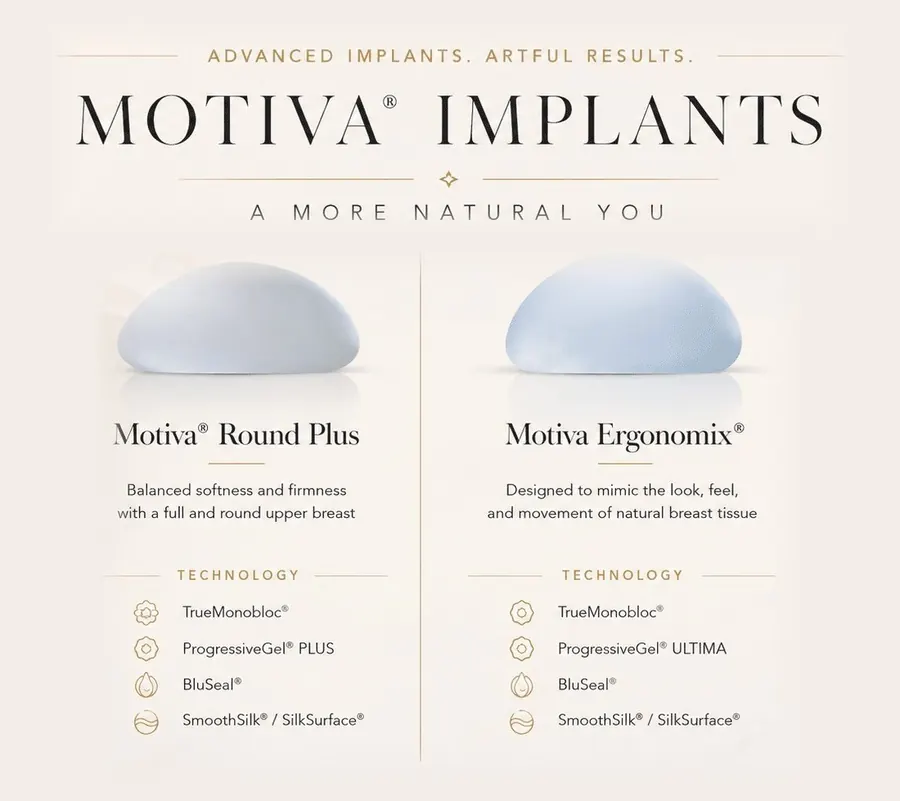
| SmoothSilk® Round | SmoothSilk® Round Ergonomix® | |
|---|---|---|
| Gel | ProgressiveGel Plus®, a firmer cohesive gel | ProgressiveGel Ultima®, a softer, more elastic gel |
| Shape | Holds a round shape, with more fullness in the upper breast | Changes shape with gravity: a natural slope when you stand, rounder when you lie down |
| Feel | Soft, with a little more structure | The softest Motiva® option available in the U.S. |
| Incision | Standard incision for its size | Designed to be inserted through a small incision |
| Often chosen for | Patients who want visible upper-breast fullness and cleavage | Patients who want the most natural slope and movement |
Many of our patients choose Ergonomix® for its natural look and movement. Others want the fuller, rounder upper breast that Round gives. At your consultation, Dr. Salama looks at your chest width, skin and existing breast tissue, and the result you have in mind, then recommends the style and size that fit your body.
Motiva® sizes and profiles
A Motiva® implant has two measurements that matter: its volume in cubic centimeters (cc) and its profile, meaning how far it projects forward from the chest. A higher profile on the same base width gives more projection.
| Profile | Projection | U.S. volume range* |
|---|---|---|
| Mini | Lowest; subtle, natural fullness | About 150–475 cc |
| Demi | Moderate; the most common middle ground | About 155–575 cc |
| Full | Highest; more forward projection | About 255–625 cc |
*Ranges from the FDA-approved Motiva® labeling, across both styles. In October 2026 the FDA approved 28 additional U.S. sizes (19 Round, 9 Ergonomix®), starting as small as 105 cc, which Establishment Labs expects to be available by the end of 2026.
Cup size isn’t a reliable way to choose an implant, because cup sizes vary between bra brands and depend on your own breast tissue. Dr. Salama sizes implants from your chest measurements and uses implant sizers in a range of sizes so you can see and feel the result before surgery.
The technology inside a Motiva® implant
SmoothSilk® surface
A smooth shell with an average surface roughness of about 4 microns. It is designed to reduce inflammation and the risk of capsular contracture, the tightening of scar tissue around an implant. Motiva® implants sold in the U.S. are not textured.
ProgressiveGel®
A highly cohesive, elastic silicone gel. ProgressiveGel Plus® in Round implants gives more structure; ProgressiveGel Ultima® in Ergonomix® is softer and responds to movement.
TrueMonobloc®
Motiva® describes its shell, patch and gel as bonded into a single unit, so the gel stays attached to the shell. This is designed to help the implant keep its shape over time.
BluSeal®
A blue-tinted barrier layer in the shell. According to Motiva®, the color lets the manufacturer confirm the barrier fully covers every implant during production, as a quality check.
Qid® microtransponder
An optional, battery-free chip offered on some Motiva® implants that stores the implant’s serial number. The Motiva® implants we use don’t include it; your implant details are recorded on your implant ID card and in Motiva’s warranty registration.
Smooth, not textured
The FDA notes that breast implant–associated anaplastic large cell lymphoma (BIA-ALCL) is more common with textured implants than with smooth ones. All Motiva® implants available in the U.S. are smooth.
What the U.S. clinical study found
Motiva® implants were approved based on the Motiva Implants Core Clinical Study, a 10-year study that followed 451 women having first-time augmentation and 109 women having revision surgery. These are the three-year results the FDA reviewed:
| At 3 years | First-time augmentation | Revision augmentation |
|---|---|---|
| Capsular contracture (Baker III/IV) | 0.5% | 6.7% |
| Implant rupture | 0.6% | 0.0% |
| Any reoperation | 6.1% | 25.8% |
| Implant removal, any reason | 1.6% | 16.5% |
| Infection | 0.9% | 0.9% |
| BIA-ALCL | 0.0% | 0.0% |
Kaplan-Meier rates from the FDA’s Summary of Safety and Effectiveness Data for Motiva® implants (P230005). Revision patients have higher rates because they are having a second surgery. Results from three years of data do not predict lifetime results; the study continues for 10 years.
For first-time augmentation, a capsular contracture rate of 0.5% at three years is low, and it is one of the main reasons Dr. Salama offers Motiva®. No implant removes the risk completely, and Dr. Salama reviews every risk with you before surgery.
Motiva® vs. other FDA-approved silicone implants
Patients often ask how Motiva® compares with the long-established brands. All FDA-approved silicone implants meet the same safety requirements, carry the same FDA boxed warning, and come with a Patient Decision Checklist. The main differences are age, design and surface.
| Motiva® | Mentor® and Natrelle® | |
|---|---|---|
| U.S. silicone approval | 2024 | 2006 |
| Surface | SmoothSilk® only (smooth) | Mentor®: smooth and textured. Natrelle®: smooth (textured BIOCELL® recalled in 2019) |
| Shape behavior | Ergonomix® changes shape with position | Round implants; Mentor® also offers textured shaped (anatomical) implants that keep a fixed shape |
| Identification | Serial number on the implant ID card; optional Qid® chip on some models | Serial number on the implant ID card |
Allergan recalled its Natrelle® BIOCELL® textured implants in 2019 because of their link to BIA-ALCL. Motiva® implants in the U.S. are smooth. If you already have implants and are thinking about switching, see replacing older implants with Motiva®.
Benefits of Motiva® implants
- Natural shape and movement. Ergonomix® implants shift with gravity, so the breast slopes naturally when you stand and softens when you lie down.
- A soft, natural feel. The elastic ProgressiveGel® is designed to feel more like breast tissue.
- Low complication rates in the U.S. study. 0.5% capsular contracture and 0.6% rupture at three years for first-time augmentation.
- Smooth surface. SmoothSilk® is designed to reduce inflammation, and smooth implants carry a lower BIA-ALCL risk than textured ones.
- Strong warranty. Lifetime rupture replacement and 10-year capsular contracture replacement, with financial assistance.
- Small incisions with Ergonomix®. The softer implant is designed to be inserted through a small incision.
- Access to Preservé. Motiva® is the implant used in the Preservé minimally invasive technique.
Preservé by Motiva®: tissue-preserving breast augmentation
Preservé is a newer, less invasive way to place Motiva® implants. Traditional augmentation creates the implant pocket by cutting and separating tissue. Preservé is designed to preserve breast tissue, nipple sensation and the chest muscle instead, using instruments made by Motiva for the technique.
How the Preservé technique works
- A small incision in the breast crease. The surgeon makes a short incision in the fold under the breast.
- Gentle tunneling. The Motiva® Channel Separator creates a path without cutting through tissue.
- Gradual stretching. The Motiva® Inflatable Balloon gently expands the space for the implant.
- No-touch placement. Dr. Salama places the implant with a Keller Funnel®, a no-touch insertion device that limits handling of the implant and its contact with the skin.
Because the technique is designed to avoid disrupting the chest muscle and less tissue is cut, Preservé is designed for a faster recovery than traditional augmentation, and it can be done with lighter anesthesia. At Elite Plastic Surgery, Preservé is offered under general or local anesthesia. It starts at $9,999, including Motiva® implants, the Preservé kit, anesthesia and the surgical fee, and it is $750 less under local anesthesia.
Who is a candidate for Preservé?
In the U.S., Preservé is offered for first-time breast augmentation, including augmentation with a breast lift, using FDA-approved Motiva® Ergonomix® implants. Dr. Salama will look at your breast tissue, skin and size goals and tell you at your consultation whether Preservé or a traditional augmentation is the better fit. Preservé implants typically don’t exceed 315 cc. In Dr. Salama’s experience, Motiva’s gel gives more projection for a given volume, so a moderate implant can still give a noticeable result.
Preservé certification
Preservé is performed by surgeons who complete Motiva’s specialized in-person training for the technique, and those surgeons are marked on Motiva’s surgeon locator. Dr. Salama has completed Motiva’s Preservé training and certification, is listed with the Preservé badge on Motiva’s surgeon locator, and offers Preservé at our Hollywood office.
Who is an ideal candidate for Motiva® implants?
You may be a good candidate if you:
- Are 22 or older (the FDA minimum age for silicone breast augmentation)
- Want fuller breasts with a natural shape, or want to restore volume lost after pregnancy, breastfeeding or weight loss
- Want to improve breast symmetry
- Have older implants you’d like to replace, including textured implants
- Are in good general health, at a stable weight, and not pregnant or breastfeeding
- Don’t smoke, or can stop for several weeks before and after surgery
- Have realistic expectations and understand that implants may need to be replaced over your lifetime
If your breasts have also lost their lift, Dr. Salama may recommend combining implants with a breast lift with implants.
Incisions, placement and the day of surgery
Dr. Salama most often places Motiva® implants through an incision in the breast crease (inframammary fold), which hides well and gives the surgeon direct control of the pocket. Preservé also uses this incision. Dr. Salama will confirm the approach that suits your anatomy and implant choice.
The implant can sit under the chest muscle (submuscular or dual-plane) or above it. Placement under the muscle adds soft-tissue coverage, which helps thinner patients. Placement above the muscle avoids cutting the muscle and usually means an easier recovery. Traditional Motiva® augmentation is usually an outpatient procedure of one to two hours, done under general or local anesthesia, and you go home the same day.
Recovery after Motiva® breast augmentation
Every recovery is different, and Dr. Salama will give you a personal plan. This is a typical timeline for traditional augmentation; recovery after Preservé is designed to be faster.
| When | What to expect |
|---|---|
| First 2–3 days | Soreness, tightness and swelling, managed with prescribed medication. Rest, short walks, and a surgical bra day and night. |
| Week 1 | First follow-up visit. Most patients return to desk work and light daily activity. |
| Weeks 2–4 | Swelling goes down. No lifting, pushing or upper-body workouts yet. |
| Weeks 4–6 | Most patients are cleared to return gradually to exercise and to wear underwire bras. |
| Months 3–6 | Implants settle into their final position and the breasts soften. Scars continue to fade over the first year. |
Traveling for surgery? See our guide for out-of-town patients.
Safety, monitoring and what the FDA requires
All breast implants sold in the U.S., including Motiva®, carry an FDA boxed warning and require a Patient Decision Checklist that you and your surgeon review and sign before surgery. This is what you should know:
- Implants aren’t lifetime devices. The longer you have them, the more likely it is that you’ll need another surgery to replace or remove them.
- Rupture screening. The Motiva® labeling recommends a first ultrasound or MRI five to six years after surgery, then every two to three years, even if you have no symptoms.
- BIA-ALCL. Breast implant–associated anaplastic large cell lymphoma is a rare cancer of the immune system that can develop around breast implants. It is more common with textured implants. No cases occurred in the U.S. Motiva® study through three years, and Establishment Labs reported in 2021 that it had no reported cases associated with Motiva® implants since 2010. No implant can be guaranteed free of risk.
- Systemic symptoms. Some patients have reported symptoms such as fatigue, joint pain and brain fog, sometimes called breast implant illness. The FDA continues to study these reports. Tell Dr. Salama about any symptoms after surgery.
- MRI. MRI is one of the recommended ways to check silicone implants for rupture. The Motiva® implants we use don’t contain the Qid® chip. Always tell the imaging center you have breast implants.
The Motiva® warranty
Motiva® implants placed in the U.S. on or after September 26, 2024 are covered by the Motiva Health Program. Motiva recommends registering your implants within 90 days of surgery. An upgraded Motiva Health Program Plus is available for a one-time fee of $250.
| Event | Motiva Health Program (included) | Health Program Plus ($250) |
|---|---|---|
| Rupture | Lifetime implant replacement, plus up to $3,500 toward surgery costs within 10 years | Lifetime replacement, plus up to $5,000 within 10 years |
| Capsular contracture (Baker III/IV) | Replacement for 10 years, plus up to $2,000 within 2 years | Replacement for 10 years, plus up to $2,500 (within 5 years for first-time augmentation) |
| BIA-ALCL | Lifetime replacement, plus up to $7,500 | Lifetime replacement, plus up to $15,000 within 10 years |
Summary of the Motiva USA warranty program (July 2025 terms). Conditions and exclusions apply. Notably, BIA-ALCL coverage excludes patients who have previously had textured implants, capsular contracture coverage excludes patients who had capsular contracture with non-Motiva® implants, and revision patients have shorter coverage periods. The full terms are on Motiva USA’s website. Our team helps you register your implants after surgery.
How much do Motiva® implants cost in Miami?
| Procedure | Starting price | Includes |
|---|---|---|
| Motiva® breast augmentation | $6,500 | Motiva® implants, anesthesia and surgical fee |
| Preservé by Motiva®, general anesthesia | $9,999 | Motiva® implants, Preservé kit, anesthesia and surgical fee |
| Preservé by Motiva®, local anesthesia | $9,249 | Same as above, $750 less |
Your price depends on the implant style, whether you’re combining augmentation with a lift or another procedure, and whether it’s a first-time or revision surgery. You’ll get a written quote at your consultation. For payment plans, see forms and financing.
Replacing older implants with Motiva®
Many patients come to us to replace older implants: textured implants they’re concerned about, implants that have ruptured or hardened, or implants that are the wrong size. Motiva® implants are FDA-approved for revision augmentation. Depending on your situation, Dr. Salama may also recommend removing the old capsule (scar tissue). Learn more about breast implant exchange and breast implant removal.
Why choose Dr. Salama for Motiva® implants
- Board-certified plastic surgeon focused on breast and body surgery
- Among the first surgeons in South Florida to offer Motiva® implants
- Certified in Preservé by Motiva®, the tissue-preserving augmentation technique
- Personal sizing with implant sizers in a range of sizes, and a written quote
- Office in Hollywood, FL, between Miami and Fort Lauderdale, 15 minutes from FLL. Directions and hours
- Consultations in English and Spanish, in person or virtually
See real results in our breast augmentation before and after gallery and read patient reviews.
Motiva® implants: frequently asked questions
Are Motiva® implants FDA approved?
Yes. The FDA approved Motiva® SmoothSilk® Round and Round Ergonomix® silicone gel implants for primary and revision breast augmentation in women 22 and older on September 26, 2024.
Do Motiva® implants look and feel more natural?
They are designed to. The soft, elastic gel and, in Ergonomix®, the ability to change shape with body position give a natural slope and movement. How natural your result looks also depends on your anatomy, implant size and surgical technique.
What’s the difference between Motiva® Round and Ergonomix®?
Round uses a firmer gel and keeps a round shape with more upper-breast fullness. Ergonomix® uses a softer gel that shifts with gravity, sloping naturally when you stand and rounding out when you lie down. See the comparison table.
Is Motiva® Ergonomix2 available in the U.S.?
Not yet. Ergonomix2 is available in other countries, but it is not FDA-approved. In the U.S., Motiva® offers SmoothSilk® Round and Round Ergonomix®.
Can Motiva® implants prevent capsular contracture?
No implant can prevent it completely. The SmoothSilk® surface is designed to reduce the risk, and the U.S. study found a 0.5% capsular contracture rate at three years for first-time augmentation.
How long do Motiva® implants last?
No breast implant is a lifetime device, and there is no set expiration date. Many patients keep their implants for many years. Motiva® covers rupture with lifetime implant replacement, and you should have ultrasound or MRI screening starting five to six years after surgery.
Do Motiva® implants have a microchip?
Some Motiva® implants are offered with the optional Qid® microtransponder, a small battery-free chip that stores the implant’s serial number. The Motiva® implants we use at Elite Plastic Surgery don’t include it.
Are Motiva® implants safe with MRI?
Yes. MRI is one of the recommended ways to screen silicone implants for rupture. The Motiva® implants we use don’t contain the Qid® chip. Tell the imaging center that you have breast implants before your scan.
How much do Motiva® implants cost in Miami?
At Elite Plastic Surgery, Motiva® breast augmentation starts at $6,500, including the implants, anesthesia and surgical fee. Preservé by Motiva® starts at $9,999, including the Preservé kit, and is $750 less under local anesthesia. You’ll get a written quote at your consultation.
What is Preservé, and how is it different from regular breast augmentation?
Preservé is a minimally invasive technique for placing Motiva® implants through a small incision without cutting the chest muscle. It is designed to preserve tissue and nipple sensation and to allow a faster recovery. See Preservé by Motiva®.
Can I switch my old implants to Motiva®?
Yes. Motiva® implants are FDA-approved for revision augmentation, including replacing older textured, ruptured or hardened implants. Preservé is offered for first-time augmentation, so implant exchange is usually done with a traditional technique.
Can I breastfeed with Motiva® implants?
Many women breastfeed successfully after breast augmentation, but implants can affect breastfeeding for some women. If you plan to breastfeed, tell Dr. Salama so he can choose the incision and placement that disturb the breast tissue least.
How do I know if my surgeon is approved to use Motiva®?
Motiva USA lists surgeons who offer Motiva® implants, and those trained in Preservé, on its surgeon locator. Dr. Salama is listed there with the Preservé badge.
Do you offer consultations in Spanish?
Yes. Ofrecemos consultas en español. Lea sobre los implantes Motiva® en español.
Sources
- U.S. Food and Drug Administration. Premarket Approval P230005, Motiva SmoothSilk Round and Round Ergonomix Silicone Gel-Filled Breast Implants. accessdata.fda.gov
- U.S. Food and Drug Administration. Summary of Safety and Effectiveness Data (SSED), P230005. accessdata.fda.gov
- U.S. Food and Drug Administration. Motiva implant labeling and patient information, P230005. accessdata.fda.gov
- U.S. Food and Drug Administration. Things to Consider Before Getting Breast Implants. fda.gov
- U.S. Food and Drug Administration. Types of Breast Implants. fda.gov
- U.S. Food and Drug Administration. Questions and Answers about Breast Implant-Associated Anaplastic Large Cell Lymphoma (BIA-ALCL). fda.gov
- Motiva USA. Breast implant coverage and warranty program. motivausa.com
- Motiva USA. Preservé by Motiva. motivausa.com
- Establishment Labs. FDA approval for additional sizes of Motiva implants, October 2026. Business Wire