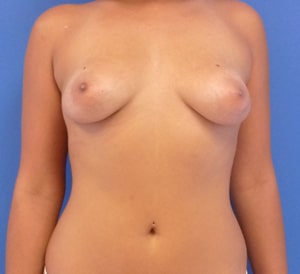
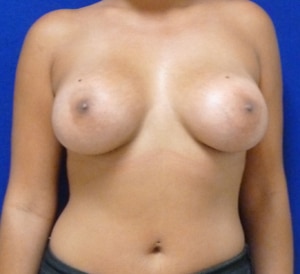
What Is Capsular Contracture?
When an implant is placed, the body walls it off with a thin layer of scar tissue called the capsule. In most women the capsule stays soft and thin for life and is never noticed. In some it thickens and contracts, squeezing the implant. The breast becomes firm, then hard; the implant rides up and looks rounder or more pointed; and in advanced cases the breast is distorted and painful. This is capsular contracture, the most common reason for revision after breast augmentation. It is not dangerous, but it does not resolve on its own once established, and the treatment is surgical: remove the implant, remove the entire capsule, and start again with a clean pocket. Board-certified plastic surgeon Dr. Moises Salama performs total capsulectomy with implant replacement or removal at Elite Plastic Surgery in Hollywood, serving Miami, for patients whose first surgery was done here or elsewhere.
Capsular contracture at a glance
- What it is
- Thickened, tightened scar capsule squeezing the implant
- Grading
- Baker I–IV; grades III and IV usually need surgery
- Treatment
- Implant removal, total capsulectomy, new implant in a fresh pocket (or no implant)
- Technique
- Total capsulectomy: the entire capsule removed; not described as “en bloc”
- Lowering recurrence
- New implant, site change, antibiotic irrigation, no-touch insertion, ADM when needed
- Anesthesia / time
- General; about 2–3 hours
- Recovery
- Desk work ~1 week; exercise 6–8 weeks; final shape ~3 months
- Surgeon
- Dr. Moises Salama, thousands of breast augmentations and revisions
Signs and Baker Grades
Surgeons grade contracture with the Baker scale, from the softest to the most severe.
| Baker grade | What you notice | What is done |
|---|---|---|
| I | Breast is soft and looks natural; the capsule is thin | Nothing; this is the normal state |
| II | Slightly firm to the touch, looks normal | Observed; sometimes massage or medication in the first months |
| III | Firm, implant looks round, high or distorted; may ache | Surgery: total capsulectomy and implant replacement |
| IV | Hard, painful, visibly distorted, often cold to the touch | Surgery; evaluation for rupture or fluid first |
Medical illustrations, simplified and not to scale.
What Causes Capsular Contracture?
- Bacterial biofilm. The leading explanation: a small number of bacteria on the implant surface at the time of surgery form a film that keeps the capsule mildly inflamed for years. This is why modern technique focuses on keeping the implant from touching skin, gloves or the air, and on antibiotic irrigation of the pocket.
- Blood or fluid around the implant after surgery (hematoma or seroma), which thickens the capsule as it heals.
- Implant rupture or gel bleed, which irritates the capsule.
- Placement above the muscle, which has a higher contracture rate than under the muscle in most studies.
- Smoking, radiation (after breast cancer treatment) and an individual tendency to form thick scar.
Contracture can appear within months or many years after the original surgery, and in one breast or both.
How Dr. Salama Treats Capsular Contracture
Once a capsule is firm, releasing it or massaging it does not make it soft again. The reliable treatment is to remove it entirely and give the new implant a clean start.
- Evaluation. Examination of both breasts, review of your implant card and operative report, and an ultrasound or MRI when rupture or fluid is suspected. If you are within your implant warranty, the team checks what it covers.
- Anesthesia and incision. General anesthesia in the practice’s state-certified surgical facility, usually through the fold incision, which gives the best access to remove a capsule completely.
- Implant removal. The implant is removed through an opening in the capsule.
- Total capsulectomy. The entire capsule is dissected free from the chest wall, the muscle and the overlying breast tissue and removed completely. Thick, calcified or contaminated capsule is sent for pathology when indicated. Dr. Salama removes the whole capsule rather than part of it, because tissue left behind is the main source of recurrence.
- A fresh pocket. When the old implant sat above the muscle, the new one is usually placed under it (a site change), which both lowers recurrence and gives better coverage. When it was already under the muscle, a new pocket is created between the old capsule bed and the muscle where possible.
- Measures against biofilm. The pocket is irrigated with an antibiotic solution, gloves are changed, the new implant is handled with a no-touch technique and inserted with a sleeve, and the time the implant is exposed is kept to a minimum.
- New implant, or none. A new implant is placed; the old one is not reused. Patients who prefer to be without implants have removal with capsulectomy, sometimes with a lift. When the tissue is thin or has been operated on more than once, an acellular dermal matrix may be used to support the implant and reduce recurrence.
- Closing. Layered closure, a small drain for a few days when a large capsule was removed, and a support bra.
Surgery takes about two to three hours and you go home the same day.
Video: Dr. Salama performs a breast implant exchange. Contains surgical footage.
Total Capsulectomy vs. En Bloc: What the Terms Mean
Patients researching capsule removal meet three terms, and they are not interchangeable.
| Term | What is removed | When it is used |
|---|---|---|
| Capsulotomy | Nothing; the capsule is cut or scored to release it | Mild cases; higher recurrence for established contracture |
| Partial capsulectomy | Part of the capsule, usually the front wall | When the back wall is thin and stuck to the ribs; leaves tissue behind |
| Total capsulectomy | The entire capsule, removed after the implant is taken out | Dr. Salama’s technique for capsular contracture |
| En bloc capsulectomy | The entire capsule with the implant still sealed inside, removed as one piece | Reserved for cases where the capsule must not be opened, such as suspected breast implant-associated ALCL |
A total capsulectomy and an en bloc capsulectomy remove the same tissue; the difference is whether the implant comes out before the capsule or inside it. Dr. Salama performs total capsulectomy for capsular contracture and does not describe it as en bloc; the en bloc term should be reserved for the specific situations that require it.
Results: Implant Exchange From the Gallery
These patients from Dr. Salama’s gallery had their implants exchanged; a revision for contracture follows the same steps with the capsule removed.

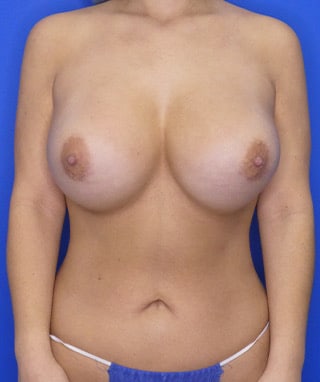


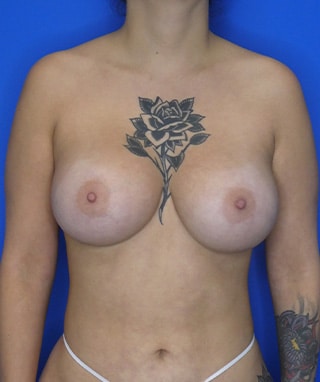
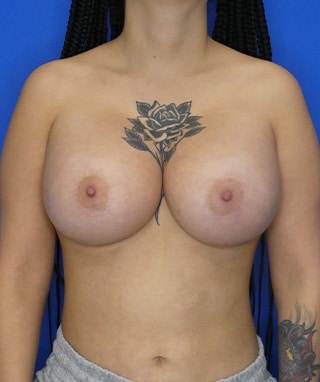
See breast revision cases → · Breast augmentation cases →
Who Needs Surgery, and When
- Grade III or IV contracture: surgery is the treatment. There is no advantage to waiting once the capsule is firm, and a hard capsule is harder to remove cleanly the longer it is left.
- Grade II in the first six months: often observed; some patients soften with time, massage or a short course of medication prescribed by Dr. Salama.
- Contracture with swelling, pain or a change in size: seen promptly to rule out rupture or fluid.
- Patients with implants from elsewhere are welcome; bring your implant card and operative report if you have them.
Smokers are asked to stop for a month before and after surgery; nicotine raises the risk of recurrence and of healing problems.
Recovery After Capsular Contracture Surgery
| Time after surgery | What to expect |
|---|---|
| Days 1–7 | Tightness and soreness, more if the implant is now under the muscle for the first time. Support bra day and night. Drain out within a few days if one was placed. Sleep on your back, elevated. |
| Week 2 | Desk work. Shower from 48 hours. Light household activity. Displacement massage begins only if Dr. Salama recommends it for your implant type. |
| Weeks 3–6 | Swelling falls; the new implant settles. Light lower-body cardio. No underwires, no upper-body training. |
| Weeks 6–8 | Cleared for exercise and lifting. Regular bras. |
| Month 3 | Final softness and shape. |
Detailed instructions for implant surgery recovery are in the breast augmentation recovery guide.
Risks and How They’re Managed
The main risk is recurrence, addressed by total capsulectomy, a fresh pocket, a new implant, antibiotic irrigation and no-touch insertion. Other risks are those of implant revision: bleeding or a blood collection (a drain is used when needed), infection, fluid collection, changes in nipple sensation, asymmetry, visible rippling where the tissue is thin (reduced by placement under the muscle or an acellular dermal matrix), a pneumothorax risk during removal of a capsule stuck to the ribs, which is rare and managed by careful dissection, and anesthesia risks.
How Much Does Capsular Contracture Surgery Cost in Miami?
Capsular contracture surgery is priced as a breast revision, and the price depends on what the revision includes. After your consultation you receive a written quote from Elite Plastic Surgery that lists each component.
What changes the price
- Implant replacement and the type and brand of the new implants, or removal without replacement.
- Warranty coverage. Manufacturer warranties often supply replacement implants, and sometimes financial assistance, for Baker III or IV contracture within a set period; bring your implant card.
- Site change or acellular dermal matrix, which add surgical time and materials.
- Adding a lift when the tissue has stretched.
Financing through CareCredit, United Medical Credit and Alphaeon Credit is available; see financing.
Why Patients Choose Dr. Salama for Revision Surgery
Patient reviews: 4.9★ on Google, 748 reviews for Elite Plastic Surgery · 4.7★ on RealSelf, 2,561 reviews (RealSelf Verified) · counts as of October 2026.
- Certified by the American Board of Plastic Surgery and the American Board of Surgery; member of the American Society of Plastic Surgeons and The Aesthetic Society.
- Surgery in the practice’s own state-certified facility in Hollywood, Florida, minutes from Miami, with board-certified anesthesia providers.
- Natrelle® and Motiva® implants, with warranty claims handled by the team.
- Bilingual team: hablamos español.
Breast Feels Hard or Looks Different? Have It Examined
Book a virtual consultation from home, or call or text (305) 933-4033. Hablamos español.
Capsular Contracture Frequently Asked Questions
What is capsular contracture?
Every breast implant is surrounded by a thin membrane of scar tissue, the capsule, which the body forms naturally and which is normally soft. Capsular contracture is when that capsule thickens and tightens around the implant, squeezing it so the breast feels firm, looks round or high, and in advanced cases becomes hard, distorted and painful. It is the most common reason for revision surgery after breast augmentation.
What does capsular contracture feel like?
Early on, the breast simply feels firmer than the other side. As it progresses the implant feels like a hard ball, sits higher on the chest, looks rounder or more pointed, and the breast can ache or feel tight, especially lying on your front. Grade IV contracture is hard, visibly distorted and painful.
What are the Baker grades of capsular contracture?
Grade I: the breast is soft and looks natural. Grade II: slightly firm but looks normal. Grade III: firm and visibly abnormal, round or high. Grade IV: hard, painful and distorted. Grades III and IV are the ones that usually need surgery; grades I and II are observed.
What causes capsular contracture?
The leading explanation is low-grade bacterial contamination of the implant surface at the time of surgery (a biofilm), which keeps the capsule inflamed. Blood collecting around the implant, implant rupture, radiation, smoking and genetics also raise the risk. It can occur months or many years after the original surgery.
How is capsular contracture treated?
Established grade III or IV contracture is treated surgically: the implant is removed, the entire capsule is removed (total capsulectomy), and a new implant is placed, usually in a fresh pocket, often under the muscle if it was above. Non-surgical options such as massage or medication are used only for early, mild cases and do not reverse a hard capsule.
What is a total capsulectomy?
Removal of the entire capsule, all of it, from around the implant, after the implant is taken out. Dr. Salama performs total capsulectomy for capsular contracture because leaving capsule behind leaves inflamed, contaminated tissue in the pocket, and the contracture is more likely to come back. The capsule is removed from the chest wall and the overlying tissue in a careful dissection, and sent for pathology when indicated.
What is the difference between a total capsulectomy and an en bloc capsulectomy?
Both remove all of the capsule. In a total capsulectomy, the implant is removed first and the whole capsule is then dissected out. In an en bloc capsulectomy, the capsule is dissected free with the implant still sealed inside it and the two are removed as one piece. En bloc is a specific term reserved for cases where the capsule must not be opened, such as suspected breast implant-associated ALCL; for capsular contracture, a total capsulectomy removes exactly the same tissue. Dr. Salama performs total capsulectomy and does not describe it as en bloc.
What is a capsulotomy, and is it enough?
A capsulotomy cuts or scores the capsule to release it without removing it. It is quicker but leaves the contracted tissue in place, so recurrence is higher. For a firm, established contracture Dr. Salama removes the capsule rather than releasing it.
Can capsular contracture come back after surgery?
It can, which is why the operation is designed to lower that risk: total removal of the old capsule, a new implant rather than the old one, placement in a fresh pocket (often changing from above the muscle to under it), antibiotic irrigation and a no-touch insertion technique, and sometimes an acellular dermal matrix. With those steps recurrence is uncommon, but no technique brings it to zero.
Can I have capsular contracture surgery without new implants?
Yes. Some patients choose implant removal with total capsulectomy and no replacement, sometimes with a breast lift to reshape the remaining tissue. See the breast implant removal page.
Does capsular contracture surgery hurt?
It is a revision operation similar in recovery to a breast augmentation: tightness and soreness for the first week, more if the new implant is placed under the muscle for the first time. Prescription medication covers the first days. Removing a thick capsule from the chest wall adds some soreness in the first week.
How long is recovery after capsular contracture surgery?
Desk work in about a week, driving once off prescription medication, a support bra for six weeks, no heavy lifting or upper-body exercise for six to eight weeks, and the final shape at three months. A small drain is sometimes used for a few days after a capsulectomy.
Is capsular contracture dangerous?
Not in itself; it is a problem of comfort and appearance. But a hard, painful capsule should be evaluated, because a late-onset firm capsule with swelling can occasionally signal a ruptured implant or, rarely, a fluid collection that needs testing. Dr. Salama examines you and may order an ultrasound or MRI.
Is capsular contracture covered by insurance or the implant warranty?
Insurance rarely covers it after cosmetic augmentation. Implant manufacturers’ warranties (Natrelle®, Motiva®, Mentor®) often provide replacement implants and sometimes financial assistance for Baker grade III or IV contracture within a set number of years of the original surgery; bring your implant card and Dr. Salama’s team will check what your warranty covers.
How much does capsular contracture surgery cost in Miami?
It is priced as a breast revision and depends on whether new implants are placed, whether a site change or lift is added and whether an acellular dermal matrix is used. You receive a written quote from Elite Plastic Surgery after the consultation that lists the surgeon’s fee, anesthesia, the facility, implants and post-operative care. Warranty replacement implants reduce the cost when they apply; financing is available.
Why choose Dr. Salama for capsular contracture surgery?
Dr. Moises Salama has performed thousands of breast augmentations and revisions over more than two decades, performs total capsulectomy himself in every contracture case, and uses the pocket change, no-touch and antibiotic-irrigation techniques that lower recurrence. Patients whose first surgery was elsewhere are welcome.
Sources
- U.S. Food and Drug Administration, Risks and complications of breast implants.
- American Society of Plastic Surgeons, Breast implant revision.
- Adams WP et al. Macrotextured breast implants with defined steps to minimize bacterial contamination around the device (the 14-point plan). Plastic and Reconstructive Surgery, 2017.
- Elite Plastic Surgery breast revision gallery.