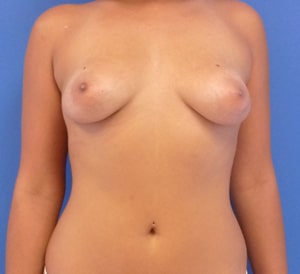
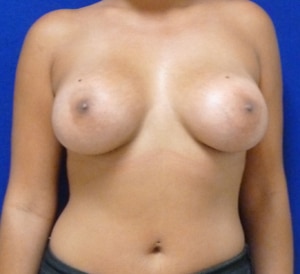
What Are Tuberous Breasts?
Tuberous breasts, also called tubular or constricted breasts, are a difference in how the breast develops during puberty. A ring of tight tissue at the base of the breast stops it from expanding outward and downward, so the breast grows narrow and long instead of round, the fold under the breast sits high, the lower half stays empty, and breast tissue pushes forward through the areola, making it puffy and enlarged. One or both breasts can be affected, and the two sides usually differ.
Many women with tuberous breasts never hear the term until a consultation. They know their breasts look “different,” sit far apart or don’t match, and they have often been told that an ordinary breast augmentation will fix it. It will not. An implant placed behind a constricted breast produces a round implant with the same narrow breast in front of it. Correcting tuberous breasts means releasing the constriction, lowering the fold, filling the lower pole and reshaping the areola, in one carefully planned operation. Board-certified plastic surgeon Dr. Moises Salama performs this correction at Elite Plastic Surgery in Hollywood, serving Miami.
Tuberous breast correction at a glance
- Also called
- Tubular breasts, constricted breasts, tuberous breast deformity
- Signs
- Narrow base, high fold, empty lower half, puffy areola, wide gap, asymmetry
- Correction
- Release of the constriction, fold lowering, dual-plane implant, areola reduction; lift when needed
- Incision
- Around the areola (periareolar); sometimes in the new fold
- Anesthesia / time
- General; about 2–3 hours
- Recovery
- Light activity in about a week; exercise at 6 weeks; final shape 3–6 months
- Staging
- One surgery for most patients; severe cases may be staged
- Surgeon
- Dr. Moises Salama, thousands of breast augmentations
Signs of Tuberous Breasts
- A narrow base. The breast attaches to the chest over a small area, so it looks long and tube-shaped from the side.
- A high breast fold. The crease under the breast sits higher than normal, which makes the breast look as if it is hanging from a short ledge.
- An empty lower pole. Most of the volume is behind the areola; the lower half of the breast is flat.
- A puffy, enlarged areola. Breast tissue herniates forward through the areola, so it bulges and widens.
- A wide gap between the breasts and a nipple that points downward.
- Asymmetry. One breast is often more constricted or smaller than the other.
Medical illustrations, simplified and not to scale.
How Tuberous Breasts Are Graded
Surgeons grade tuberous breasts by how much of the breast base is constricted, which decides how much release and reshaping is needed.
| Grade | What is constricted | What correction usually needs |
|---|---|---|
| Grade I | The lower inner quarter only; the breast looks slightly lifted on the inside | Release of the lower pole, dual-plane implant, often areola reduction |
| Grade II | The whole lower half; high fold, empty lower pole, downward-pointing nipple | Full lower-pole release, fold lowering, dual-plane implant, areola reduction; a lift if the nipple is low |
| Grade III | The entire base; very small, narrow breast with a large herniated areola | All of the above; the tightest cases may be staged with tissue expansion before the final implant |
Dr. Salama grades each breast separately at your consultation, because the two sides are rarely the same grade.
Why a Standard Breast Augmentation Isn’t Enough
A breast implant adds volume behind the breast; it does not change the shape of the breast in front of it. In a tuberous breast the problem is the shape: a tight lower pole, a high fold and a puffy areola. Put an implant behind that and you get a “double bubble,” the round implant showing below the original high fold, with the same narrow breast and puffy areola sitting on top. The correction has to release the tissue so it can drape over the implant, move the fold down to where it belongs, and reduce the areola so the breast reads as round rather than conical.
Video: Dr. Salama performs a dual-plane correction of tuberous breasts. Contains surgical footage.
How Dr. Salama Corrects Tuberous Breasts
- Planning. At your consultation Dr. Salama measures the base width, the fold position, the areola diameter and the difference between the two sides, then plans the implant size and profile for each breast, often two different sizes.
- Anesthesia. General anesthesia by a board-certified anesthesia provider in the practice’s state-certified surgical facility.
- Periareolar incision. An incision around the lower edge of the areola gives access to the lower breast and allows the areola to be reduced in the same step.
- Releasing the constriction. The tight bands in the lower breast are divided with internal radial scoring, so the lower pole can expand and drape naturally.
- Lowering the fold. The high inframammary fold is released and reset at the level where it belongs, matched to the other side.
- Dual-plane implant. A silicone gel implant is placed in the dual plane: the upper part under the chest muscle for a smooth upper slope, the lower part under the released breast tissue so the implant fills the lower half. Dr. Salama uses implants such as Natrelle® and Motiva®; see the breast augmentation page for the options.
- Areola reduction and closing. The herniated areola is reduced to a normal diameter and the incision is closed around it with a purse-string suture. When the nipple sits low, a lift is combined with the correction.
The surgery takes about two to three hours and you go home the same day with a supportive bra.
Results: Symmetry Is the Goal
Dr. Salama’s gallery holds 59 breast augmentation cases, including corrections of uneven breasts with different implant sizes on each side, the same planning used for tuberous breasts.
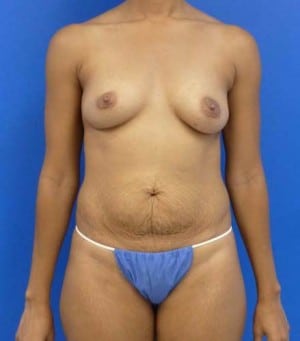
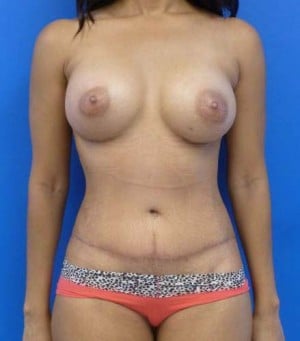
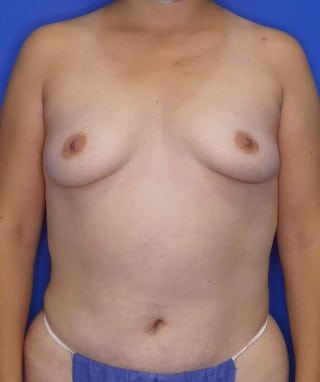
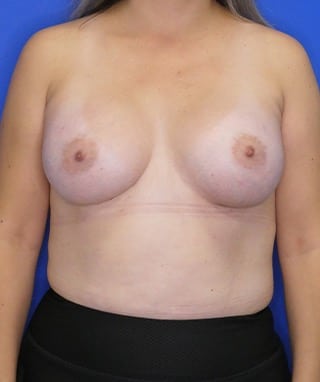
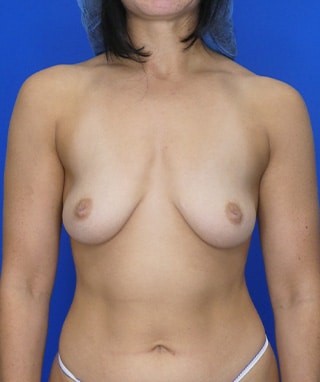
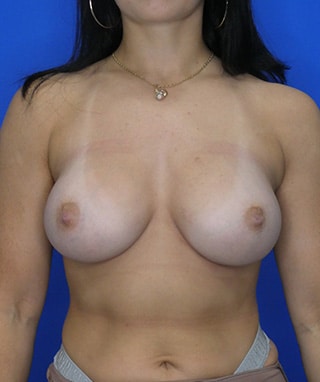
See all 59 breast augmentation cases →
Results are visible at once, but the released lower pole is swollen and firm at first. Over 3–6 months it softens and rounds out as the tissue settles over the implant, and the areola scar fades through the first year. Implants are long-lasting but not lifetime devices; most patients replace them once or twice over their lives.
Who Is a Good Candidate?
- Your breast development is complete (usually by age 18).
- Your breasts show the signs above: narrow base, high fold, empty lower half, puffy areola, asymmetry.
- You are in good health and do not smoke, or will stop before and after surgery.
- You want a rounder, fuller, more even breast and understand that symmetry will be much better, not perfect.
- You are at a stable weight and, ideally, not planning a pregnancy in the next year.
Dr. Salama does not perform fat transfer to the breast, so correction uses implants. For patients who only want the areola reduced or the asymmetry balanced without implants, he will explain what is realistic.
Recovery After Tuberous Breast Correction
| Time after surgery | What to expect |
|---|---|
| Days 1–7 | Tightness and soreness, most in the lower breast where tissue was released. Supportive bra day and night. Walk a little every hour; no reaching or lifting. |
| Weeks 2–3 | Most patients are back at desk work. Swelling begins to fall; the breasts still sit high. |
| Week 6 | Exercise and lifting resume once Dr. Salama clears you. Implants start to settle into the lower pole. |
| Months 3–6 | The lower pole softens and rounds; the final shape appears. |
| Up to 12 months | The periareolar scar flattens and fades. |
Breast massage, when Dr. Salama recommends it, helps the implants settle. Full recovery instructions are in the breast augmentation recovery guide.
Video: Recovery tips after breast augmentation.
Risks and How They’re Managed
The risks are those of breast augmentation, plus the specific ones of tuberous correction: a persistent double-bubble if the fold is not fully released, areola widening over time, residual asymmetry, capsular contracture, implant malposition, changes in nipple sensation, infection and bleeding. They are reduced by thorough release of the constriction, careful setting of the new fold, a purse-string closure of the areola, implant sizing per side, general anesthesia with full monitoring in a state-certified facility, and close follow-up. If a lower pole stays tight, a touch-up release is possible once healing is complete.
How Much Does Tuberous Breast Correction Cost in Miami?
Correction starts in the breast augmentation range, which in Miami typically costs between $6,000 and $11,000 in total with implants included, and rises when areola reduction, fold lowering or a lift add surgical time. Nationally, the surgeon’s fee for breast augmentation alone averages $4,575 to $8,000, according to the American Society of Plastic Surgeons.
What your quote includes
Your written quote from Elite Plastic Surgery lists the surgeon’s fee, the anesthesia fee, your implants and your post-operative care. Financing through CareCredit, United Medical Credit and Alphaeon Credit is available; see financing.
What changes the price
- Grade of constriction and whether both sides need release.
- Areola reduction and a lift, which add time.
- Implant type and brand: saline, silicone gel, form-stable, Natrelle® or Motiva®.
- Staging, in the rare severe case that needs tissue expansion first.
Why Patients Choose Dr. Salama
Patient reviews: 4.9★ on Google, 748 reviews for Elite Plastic Surgery · 4.7★ on RealSelf, 2,561 reviews (RealSelf Verified) · counts as of October 2026.
- Certified by the American Board of Plastic Surgery and the American Board of Surgery; member of the American Society of Plastic Surgeons and The Aesthetic Society.
- He performs every surgery himself, in the practice’s own state-certified facility in Hollywood, Florida, minutes from Miami.
- Each breast is planned on its own: implant size, release and fold position are set per side to balance asymmetry.
- Bilingual team: hablamos español.
Find Out If Your Breasts Are Tuberous, and What Would Correct Them
Start with a virtual consultation: send a few photos from home and Dr. Salama reviews them himself. Or call or text (305) 933-4033. Hablamos español.
Tuberous Breasts Frequently Asked Questions
What are tuberous breasts?
Tuberous breasts, also called tubular or constricted breasts, are a developmental difference in which the breast grows with a narrow base, a high breast fold, little fullness in the lower half and often a puffy, enlarged areola. The breast looks long and narrow, like a tube, rather than round. One or both breasts can be affected, usually unevenly.
What causes tuberous breasts?
A ring of tight connective tissue at the base of the developing breast, present from birth, limits how far the breast can expand outward and downward during puberty. Breast tissue then pushes forward through the weakest point, the areola, which is why the areola looks puffy. It is not caused by anything you did, and it is not a disease.
How do I know if I have tuberous breasts?
Common signs are a wide gap between the breasts, a breast fold that sits high on the chest, a narrow base with most of the volume behind the areola, areolas that are large or puffy, and a noticeable difference between the two sides. Dr. Salama confirms it with an examination and grades how much of the breast is constricted.
Can tuberous breasts be fixed without implants?
Mild cases with enough breast tissue can be improved by releasing the constricting bands and reducing the areola, sometimes with a lift. Most patients, though, have too little lower-pole volume, so an implant is needed to fill out the shape. Dr. Salama does not perform fat transfer to the breast.
What surgery corrects tuberous breasts?
Tuberous breast correction combines several steps in one operation: releasing the tight tissue in the lower breast with internal radial scoring, lowering the breast fold to a normal position, placing an implant in the dual plane to fill the lower half, and reducing the areola through a periareolar incision. A lift is added when the nipple sits low.
Why is the dual-plane technique used for tuberous breasts?
In the dual plane, the upper part of the implant sits under the chest muscle and the lower part sits under the released breast tissue. The muscle smooths the upper edge of the implant, while the uncovered lower pole lets the implant expand the constricted tissue, which is exactly where a tuberous breast needs volume.
Will my breasts match after surgery?
They will match far better. Tuberous breasts are usually asymmetric, so Dr. Salama often uses implants of different sizes or releases one side more than the other to balance them. Perfect symmetry is not possible in any breast surgery, but the difference becomes hard to notice.
Can tuberous breast correction be done in one surgery?
For most patients, yes. In severe cases with very tight skin, Dr. Salama may stage the correction: first expanding the tissue, then placing the final implant months later. He tells you at the consultation which applies to you.
What is the recovery like?
Similar to breast augmentation: light activity in about a week, a supportive bra for six weeks, no heavy lifting or upper-body exercise for six weeks. Because the lower breast tissue was released, the lower pole softens and rounds out over 3–6 months as the swelling settles.
Will I have scars?
A periareolar scar around the edge of the areola, which blends into the color change between areola and skin, and sometimes a scar in the new breast fold. If a lift is needed, a vertical scar is added. All fade over the first year.
Can I breastfeed after tuberous breast correction?
Tuberous breasts themselves can make breastfeeding harder because there is less glandular tissue. Surgery does not remove gland tissue, and implants do not affect milk production, though the periareolar incision carries a slightly higher risk of affecting the ducts than other incisions.
How much does tuberous breast correction cost in Miami?
Correction starts in the breast augmentation range, typically $6,000 to $11,000 in Miami with implants included, and rises when areola reduction, fold lowering or a lift add surgical time. Your written quote from Elite Plastic Surgery lists the surgeon’s fee, anesthesia, implants and post-operative care. Financing is available.
Is tuberous breast surgery covered by insurance?
It is considered cosmetic by most insurers, even though tuberous breasts are a congenital difference. Some plans make exceptions for severe asymmetry; our team can give you the documentation to ask.
At what age can tuberous breasts be corrected?
Once breast development is complete, usually by 18. Many patients wait years because they did not know the condition had a name or a fix.
Why choose Dr. Salama for tuberous breast correction?
Tuberous breasts need more than an implant; they need the constriction released, the fold moved and the areola reshaped in the right proportions, or the result looks like an implant sitting behind the same narrow breast. Dr. Salama has specialized in breast and body surgery for more than two decades and has performed thousands of breast augmentations, including dual-plane correction of tuberous breasts.
Sources
- American Society of Plastic Surgeons, Breast augmentation.
- Grolleau JL et al. Breast base anomalies: treatment strategy for tuberous breasts, minor deformities, and asymmetry. Plast Reconstr Surg 1999 (grading system).
- Elite Plastic Surgery breast augmentation gallery.