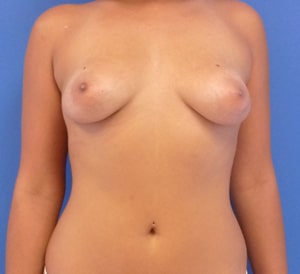
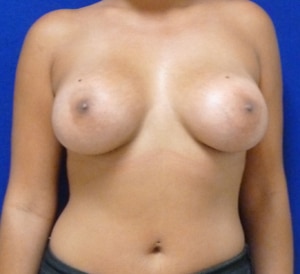
What Is Symmastia?
Symmastia is a complication of breast augmentation in which the two implant pockets connect across the breastbone. The skin and tissue that normally stay attached to the sternum lift off it, the implants slide toward each other, and the breasts look like one continuous mound with no cleavage; patients call it “uniboob” or “breadloafing.” It can appear in the first weeks after an augmentation or develop over months as the implants push a weakened midline apart. It is not dangerous, but it does not get better on its own, and it is one of the more technically demanding breast revisions to correct. Board-certified plastic surgeon Dr. Moises Salama performs symmastia repair at Elite Plastic Surgery in Hollywood, serving Miami, for patients whose first surgery was done here or elsewhere.
Symmastia repair at a glance
- Also called
- Uniboob, breadloafing, medial implant malposition
- Cause
- Over-dissected or over-wide implant pockets joining across the sternum
- Repair
- Medial capsulorrhaphy with permanent sutures; implant repositioning or exchange; mesh or acellular dermal matrix when tissue is thin; neo-subpectoral pocket in difficult cases
- Incision
- Usually through the original augmentation scar
- Anesthesia / time
- General; about 2–3 hours
- After surgery
- Midline strap and support bra for ~6 weeks; no chest exercise for 8–12 weeks
- Recovery
- Desk work ~1 week; final shape ~3 months
- Surgeon
- Dr. Moises Salama, thousands of breast augmentations and revisions
Signs of Symmastia
- No cleavage. The breasts touch or merge in the middle, in or out of a bra.
- Skin tenting over the breastbone. The skin between the breasts lifts away from the sternum instead of lying flat against it, most visible lying down.
- Implants that drift inward. One or both implants sit too close to the midline, and can be pushed across it.
- A bra band that does not sit flat on the sternum, and cleavage that looks like a single mound in swimwear.
- Sometimes visible rippling or an implant edge at the inner breast where the tissue is thin.
Medical illustrations, simplified and not to scale.
What Causes Symmastia?
Symmastia is almost always a consequence of breast implant surgery, and it comes from the midline being asked to hold more than it can.
- Over-dissection of the inner pocket. Releasing the tissue too far toward or across the sternum, often in an attempt to create more cleavage, removes the attachment that keeps the pockets apart.
- Implants too wide for the chest. An implant whose base is wider than the breast footprint has nowhere to go but toward the middle (and the armpit).
- Over-release of the chest muscle at its sternal attachment in submuscular placement, which lets the implant slide under the midline skin.
- Repeated exchanges to larger implants, each stretching the midline a little more.
- Thin tissue and a narrow sternum, which make the midline easier to breach and harder to repair.
Because the cause is mechanical, the repair has to be mechanical too: rebuild the wall, fit the implant to the space, and protect the repair while it heals.
How Dr. Salama Repairs Symmastia
- Assessment. At the consultation Dr. Salama measures the chest and breast base, examines the tissue over the sternum standing and lying down, reviews the implants you have (size, base width, profile, plane) and the operative report from your first surgery if it is available.
- Anesthesia and incision. General anesthesia in the practice’s state-certified surgical facility, usually through the original augmentation scar.
- Implant removal and pocket inspection. The implants are removed and the joined pockets are examined to see how far the midline has been breached and how thick the remaining tissue is.
- Medial capsulorrhaphy. The inner wall of each pocket is closed with a row of permanent sutures that fix the capsule and the overlying tissue to the tissue over the sternum, rebuilding the wall between the pockets. The sutures are placed from the top of the pocket to the fold so the new border is continuous.
- Reinforcement when needed. If the tissue is thin, has been repaired before or must support a large implant, Dr. Salama reinforces the inner pocket wall with an acellular dermal matrix such as Strattice® or an absorbable surgical mesh, sutured across the repair like an internal sling.
- Neo-subpectoral pocket in difficult cases. When the old pocket cannot be repaired reliably, a new pocket is created between the old capsule and the chest muscle, and the old capsule is closed off behind it, so the implant sits in fresh, unstretched tissue.
- Implant placement. The original implants are replaced with implants whose base width fits the corrected pocket, often a narrower or higher-profile implant that keeps volume while sitting within the breast footprint; the same implants are reused only when they fit.
- Closing and support. The incisions are closed in layers and a support bra with a midline strap is applied in the operating room.
Surgery takes about two to three hours and you go home the same day.
Video: Dr. Salama on correcting breast implant asymmetry and malposition.
Results: Pocket Corrections From the Gallery
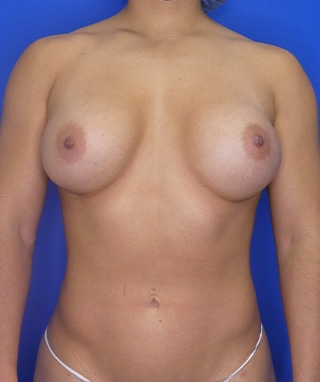
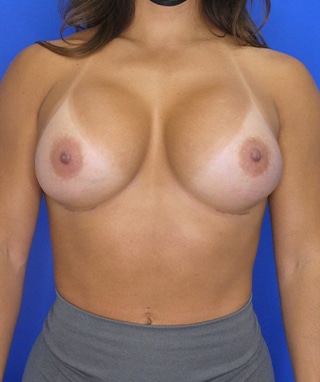
These patients from Dr. Salama’s gallery had their implant pockets corrected; case 1259 includes a capsulorrhaphy with Strattice® acellular dermal matrix, the same reinforcement used in symmastia repair.

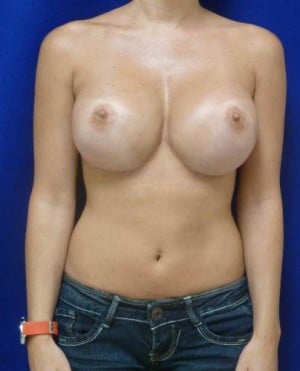


See all breast revision cases →
Who Is a Candidate for Symmastia Repair?
- You have had breast augmentation or an implant exchange and your breasts have merged at the midline, or the skin over your breastbone has lifted off the bone.
- Your first surgery was at least three to six months ago, so the tissue has settled and the extent of the problem is clear (earlier if the implants are crossing the midline).
- You are in good health, at a stable weight and do not smoke, or will stop before and after surgery; nicotine is the main threat to a repair that depends on tissue healing to bone.
- You accept that the repair may mean a narrower implant and a slightly wider gap than you had hoped for, because that is what makes the repair last.
Dr. Salama also repairs symmastia in patients whose first surgery was performed elsewhere; bring your implant card and operative report if you have them.
Recovery After Symmastia Repair
| Time after surgery | What to expect |
|---|---|
| Days 1–7 | Soreness and tightness along the breastbone and the usual implant-surgery tightness. Support bra and midline strap day and night. Sleep on your back, elevated. No reaching or lifting over 10 lb. |
| Week 2 | Desk work. Shower from 48 hours. Strap and bra continue; no underwires, no push-up bras. |
| Weeks 3–6 | Light lower-body activity. The midline is healing to the bone; the strap stays on, day and night, until Dr. Salama clears you at about six weeks, then at night for a few more weeks. |
| Weeks 8–12 | Cleared for upper-body and chest exercise, gradually. Regular bras once cleared. |
| Month 3 | Final position and shape; a natural gap of one to two finger-widths with the skin flat on the sternum. |
No breast massage is performed after symmastia repair unless Dr. Salama specifically instructs it. General implant-surgery recovery details are in the breast augmentation recovery guide.
Risks and How They’re Managed
The main risk is recurrence, which is why Dr. Salama uses permanent sutures, reinforces thin tissue with mesh or acellular dermal matrix, fits the implant to the corrected pocket and insists on the strap and the exercise restrictions. The other risks are those of any implant revision: bleeding or a blood collection, infection (slightly higher when mesh is used, managed with antibiotics and sterile technique), capsular contracture, visible or palpable sutures at the inner breast in thin patients, asymmetry, changes in nipple sensation and anesthesia risks. A repair that ends up too close together is more likely to recur than one with a slightly wider gap, so the gap is planned deliberately.
How Much Does Symmastia Repair Cost in Miami?
Symmastia repair is priced as a breast revision, and the price depends on what the repair needs. After your consultation you receive a written quote from Elite Plastic Surgery that lists each component.
What changes the price
- Implant replacement: whether new implants are needed, and their type and brand (Natrelle®, Motiva®).
- Mesh or acellular dermal matrix, which is priced per sheet and adds materially to the cost when needed.
- A neo-subpectoral pocket or capsulectomy, which add surgical time.
- Combining with other procedures, such as a lift, in the same surgery.
Financing through CareCredit, United Medical Credit and Alphaeon Credit is available; see financing.
Why Patients Choose Dr. Salama for Revision Surgery
Patient reviews: 4.9★ on Google, 748 reviews for Elite Plastic Surgery · 4.7★ on RealSelf, 2,561 reviews (RealSelf Verified) · counts as of October 2026.
- Certified by the American Board of Plastic Surgery and the American Board of Surgery; member of the American Society of Plastic Surgeons and The Aesthetic Society.
- Surgery in the practice’s own state-certified facility in Hollywood, Florida, minutes from Miami, with board-certified anesthesia providers.
- Revisions of surgery performed elsewhere are welcome; the first step is a careful look at what was done and what the tissue can now hold.
- Bilingual team: hablamos español.
Think You Have Symmastia? Let Dr. Salama Take a Look
Start with a virtual consultation: send a few photos from home and Dr. Salama reviews them himself. Or call or text (305) 933-4033. Hablamos español.
Symmastia Repair Frequently Asked Questions
What is symmastia?
Symmastia is a complication of breast augmentation in which the two implant pockets join across the breastbone, so the breasts appear to merge into one with no cleavage. The skin over the sternum lifts off the bone and the implants can slide toward each other. Patients call it “uniboob” or “breadloafing.” It does not correct itself and is repaired surgically.
What causes symmastia?
Over-dissection of the inner edge of the implant pockets during the first augmentation, implants that are too wide for the chest, over-release of the chest muscle where it attaches to the sternum, or repeated large implant exchanges that weaken the midline tissue. Thin tissue and a narrow chest raise the risk. It can appear soon after surgery or develop over months as the implants push the weakened midline apart.
Can symmastia be fixed?
Yes. Dr. Salama repairs symmastia by closing the inner wall of each pocket to the breastbone with permanent internal sutures (medial capsulorrhaphy), usually placing new or narrower implants in a corrected position, and reinforcing the midline with a supportive mesh or acellular dermal matrix when the tissue is thin. A midline strap is worn afterward while the repair heals.
Does symmastia repair mean smaller implants?
Often, but not always. A narrower implant of the same or slightly smaller volume, or a higher-profile implant with a smaller base, keeps fullness while fitting inside the corrected pockets. What matters is that the implant base is narrower than the distance from the sternum to the outer breast fold on each side.
What is a capsulorrhaphy?
The capsule is the thin scar membrane the body forms around every implant. A capsulorrhaphy stitches part of that capsule to itself or to the chest wall to make the pocket smaller or move its border. In symmastia repair, the inner capsule is stitched to the tissue over the sternum in a row of permanent sutures, rebuilding the wall between the two pockets.
What is a neo-subpectoral pocket?
A new pocket created in a fresh plane, between the old capsule and the chest muscle, so the implant sits in tissue that has never been stretched. Dr. Salama uses it when the old pocket is too damaged or too large to repair reliably; the old capsule is collapsed and sutured closed behind the new pocket.
When is mesh or acellular dermal matrix used in symmastia repair?
When the midline tissue is thin, has already been repaired once, or must hold a large implant. The sheet (an acellular dermal matrix such as Strattice® or an absorbable mesh) is sutured across the inner pocket wall like an internal sling, adding strength that sutures alone cannot. Dr. Salama’s gallery includes a pocket repair with Strattice® placement.
Will my cleavage look normal after symmastia repair?
The goal is a natural gap of about one to two finger-widths between the breasts, with the skin attached to the sternum and each implant centered under its own breast. Because the midline tissue has been weakened, the repair is designed to err toward a slightly wider gap rather than a narrow one; a repair pushed too close together is the main cause of recurrence.
Can symmastia come back after repair?
Recurrence is the main risk of the operation, especially if the repair is strained early or implants that are too wide are used again. Permanent sutures, mesh reinforcement when the tissue is thin, properly sized implants, the midline strap for six weeks and avoiding chest exercise for eight to twelve weeks all lower the chance. If it recurs, a neo-subpectoral pocket with mesh is the usual next step.
How long is recovery after symmastia repair?
Similar to a breast augmentation revision: desk work in about a week, the midline strap and a supportive bra day and night for about six weeks, no lifting over 10 pounds for two weeks, no upper-body or chest exercise for eight to twelve weeks, and the final shape at three months. The repair itself is sore along the breastbone for the first two weeks.
Is symmastia repair painful?
The first week brings soreness and tightness along the breastbone where the sutures hold the tissue down, and the usual tightness of implant surgery. Prescription medication covers the first days; most patients are on over-the-counter medication within a week.
What happens if symmastia is left untreated?
It does not improve. The implants continue to drift toward the middle, the skin over the sternum stretches further, the breasts look worse in bras and swimwear, and the eventual repair becomes harder because the tissue is thinner. Early repair is easier and more reliable.
Can symmastia happen without implants?
A congenital form exists, in which breast tissue crosses the midline without implants, but it is rare. Almost all symmastia seen in practice follows breast augmentation or implant exchange.
How do I know if I have symmastia or just close-set implants?
Lie flat on your back. If the breasts stay together and the skin over the breastbone tents up away from the bone, or if you can push one implant toward the other and it crosses the midline, it is symmastia. Close-set implants with the skin still attached to the sternum are a different problem (an implant that is simply too wide). Dr. Salama confirms by examination.
How much does symmastia repair cost in Miami?
Symmastia repair is priced as a breast revision, and the cost depends on whether the implants are replaced, whether mesh or acellular dermal matrix is needed and whether a new pocket is created. You receive a written quote from Elite Plastic Surgery after the consultation that lists the surgeon’s fee, anesthesia, the facility, implants and any mesh, and post-operative care. Financing is available.
Why choose Dr. Salama for symmastia repair?
Symmastia is a revision problem, and revision surgery needs a surgeon who performs a high volume of breast implant surgery and sees the complications of first surgeries done elsewhere. Dr. Moises Salama has performed thousands of breast augmentations and revisions over more than two decades, uses permanent-suture capsulorrhaphy, neo-subpectoral pockets and acellular dermal matrix as each case needs, and performs every repair himself.
Sources
- American Society of Plastic Surgeons, Breast implant revision.
- Spear SL, Bogue DP, Thomassen JM. Symmastia after breast augmentation. Plastic and Reconstructive Surgery, 2006 (classification and capsulorrhaphy repair).
- Maxwell GP, Gabriel A. The neopectoral pocket in revisionary breast surgery. Aesthetic Surgery Journal, 2008.
- Elite Plastic Surgery breast revision gallery.