

What Is a BBL?
A BBL, short for Brazilian butt lift, is a surgery that reshapes and enlarges the buttocks with your own fat. The surgeon removes fat with liposuction from places you don’t want it, usually the abdomen, flanks, back or thighs, purifies it, and injects it into the buttocks and hips. Two things change at once: the waist and back get slimmer, and the buttocks get fuller and rounder. That contrast is what creates the hourglass shape a BBL is known for.
Despite the name, a BBL is not a “lift” in the surgical sense. No skin is removed. It is a fat transfer, also called buttock augmentation with fat grafting. Board-certified plastic surgeon Dr. Moises Salama of Elite Plastic Surgery in Hollywood, serving Miami, has performed more than 8,000 BBLs and helped popularize the modern technique. This guide explains how the surgery works, who it is for, what it can and cannot do, and how it is made safe.
BBL at a glance
- Also called
- Brazilian butt lift, gluteal fat grafting, buttock augmentation with fat transfer
- What it does
- Slims the donor areas and adds volume and shape to the buttocks and hips
- Fat source
- Your own fat from the abdomen, flanks, back, thighs or arms
- Where the fat goes
- Only in the fatty layer above the gluteal muscle, placed under ultrasound guidance
- Anesthesia
- General, in a state-certified surgical facility
- Surgery time
- About 2–3 hours; home the same day
- Recovery
- Light activity in 7–10 days; no sitting directly on the buttocks for about 6 weeks
- Results
- Visible at once; final shape at 3–6 months; surviving fat is permanent
How a BBL Works, Step by Step
A BBL is really two procedures in one operation. Here is what happens from the moment you are asleep.
Medical illustrations, simplified and not to scale.
- Anesthesia and marking. Dr. Salama marks the donor areas and the target shape with you standing, then general anesthesia is given by a board-certified anesthesia provider.
- Liposuction (fat harvest). Through incisions a few millimeters long, fat is removed with power-assisted liposuction (PAL) and ultrasound-assisted liposuction (UAL). PAL uses a vibrating cannula that moves through fat with less force; UAL uses ultrasound energy to loosen fat first. Both help collect fat gently, which matters because gently handled fat survives better after transfer.
- Processing. The harvested fat is filtered and purified to remove the tumescent fluid, oil and blood, leaving concentrated fat ready for grafting.
- Fat transfer under ultrasound guidance. Using a handheld ultrasound probe on the skin, Dr. Salama watches the cannula tip on a screen while he injects, so every pass of fat goes into the subcutaneous fat layer above the gluteal muscle. The fat is placed in many thin tunnels rather than one pool, so each strand of fat sits next to tissue that can feed it a blood supply.
- Shaping and closing. Volume is distributed to round the upper buttock, fill hip dips and improve projection according to your plan. The small incisions are closed and a compression garment is applied.
Video: Dr. Salama explains the ultrasound-assisted BBL.
Where Does the Fat Come From?
The donor areas are chosen for two reasons: they hold fat you want gone, and removing it sharpens the contrast with the buttocks. The most common combination is the abdomen, flanks (love handles) and lower back, sometimes called lipo 360 because it circles the waist. The upper back, inner and outer thighs and upper arms are added when more fat is needed or when they are part of your goals.
How much fat can be harvested depends on how much you carry and where. Most of Dr. Salama’s patients receive between 500 and 1,500 cc of purified fat per side. Lean patients with less donor fat are treated with a skinny BBL approach that uses smaller volumes for shape and proportion.
Where Does the Fat Go?
This is the most important question in BBL safety, and the answer is simple: only into the fatty layer above the gluteal muscle. The buttock has three layers: skin, a thick layer of fat, and the gluteal muscles underneath. Large veins run through and beneath the muscle. If fat is injected into or below the muscle, it can enter those veins and travel to the lungs, a fat embolism, which is the cause of the deaths that gave the BBL a dangerous reputation. Keeping the fat in the subcutaneous layer avoids those veins entirely.
Why ultrasound matters: without imaging, a surgeon relies on feel to judge the depth of the cannula. With ultrasound, Dr. Salama sees the cannula tip and the fat–muscle boundary on a screen during every injection. He adopted ultrasound guidance for every BBL as a practice decision, to provide the safest setting for this procedure.
Within the fat layer, placement still shapes the result. Fat high on the buttock lifts the appearance; fat on the outer hip fills hip dips and widens the silhouette; fat in the center adds projection. Dr. Salama plans this distribution with you before surgery based on your frame and the shape you want.
Video: Dr. Salama on fat placement above the muscle.
What a BBL Does and Doesn’t Do
| A BBL does | A BBL does not |
|---|---|
| Add volume and projection to flat or small buttocks | Remove loose, hanging skin (that needs a traditional butt lift) |
| Round out a square or V-shaped buttock | Change the underlying bone structure of the pelvis |
| Fill hip dips and widen the hips | Treat cellulite reliably (some improvement is possible) |
| Slim the waist, back and thighs through liposuction | Replace weight loss; it is a shaping surgery, not a weight-loss surgery |
| Create a natural feel, because the result is living fat | Give unlimited size; the limit is how much fat you have and how much the tissue can safely hold |
Who Is a Good Candidate for a BBL?
You are likely a good candidate if you:
- Want fuller, rounder or more lifted-looking buttocks, or better waist-to-hip proportion.
- Have enough fat somewhere on your body to harvest, even in small amounts spread across several areas.
- Are in good health, with a BMI of 35 or under (the practice’s limit for a BBL).
- Do not smoke, or will stop well before and after surgery; nicotine starves the transferred fat of blood supply.
- Have realistic expectations about size, and can follow the six-week no-sitting rule.
Who should consider something else: patients whose main concern is sagging skin after massive weight loss (a traditional butt lift), patients with almost no body fat who want a large change (butt implants), and anyone with an uncontrolled medical condition. In Dr. Salama’s experience, the easiest candidates sit a little above their ideal weight — roughly 10 to 30 extra pounds gives plenty of fat to work with — so he advises against crash-dieting before surgery; here, extra fat is an asset. He evaluates all of this at your consultation, in person or starting with photos from home.
Video: Dr. Salama on weight before a BBL.
Types of BBL
| Type | What it means | Typical patient |
|---|---|---|
| Standard BBL | Liposuction of the abdomen, flanks and back with transfer of roughly 700–1,500 cc per side | Patients with a moderate amount of donor fat who want noticeable volume and a smaller waist |
| Skinny BBL | Smaller transfer (often 400–700 cc per side) gathered from several lean areas, placed for shape and projection | Lean patients, athletes, patients who want proportion rather than size |
| BBL with hip augmentation | Part of the fat is placed in the outer hips to fill hip dips and widen the silhouette | Patients with a straight or V-shaped lower body |
| BBL with lipo 360 or HD liposuction | Liposuction extended all the way around the torso, sometimes with etching for muscle definition | Patients who want the waist and back as sculpted as the buttocks |
| BBL revision | A second BBL to add volume, correct asymmetry or smooth irregularities from an earlier surgery elsewhere | Patients unhappy with a previous BBL or whose fat survival was low |
| Implant removal with BBL | Old buttock implants are removed and the shape is rebuilt with fat | Patients with shifted, hard or uncomfortable implants |
What BBL Results Look Like
Dr. Salama’s gallery holds 93 BBL cases, all his own patients, with back, angle and side views. Three examples show the range, from a 500 cc skinny BBL to a 1,500 cc transfer:
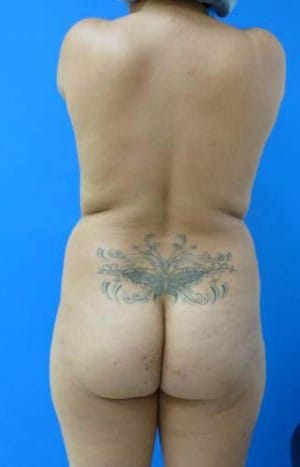
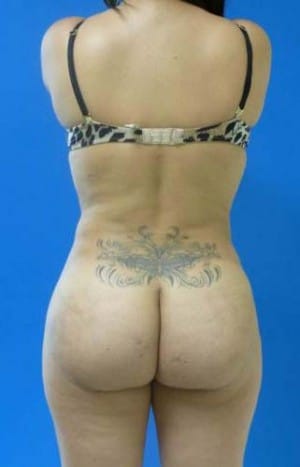
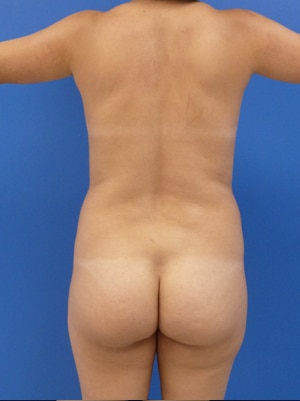
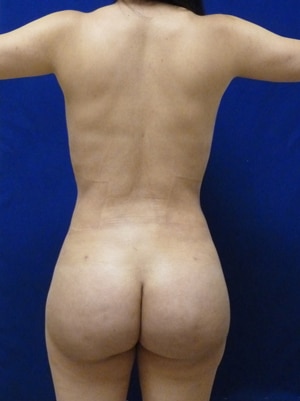
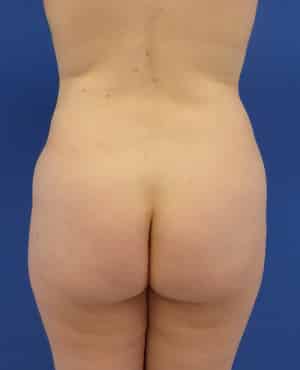
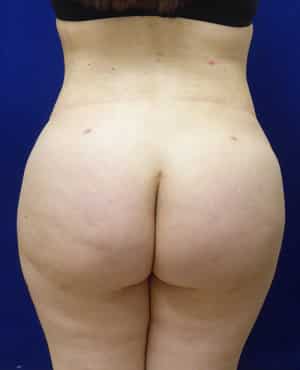
Results are visible immediately, but the buttocks are swollen and firm for the first weeks. Over 3–6 months the swelling leaves and the fat softens and settles, a stage patients call fluffing, when the buttocks look rounder and more natural. Typically 60–80% of the transferred fat survives; Dr. Salama accounts for this when he plans the volume. The fat that survives is permanent and behaves like any other fat on your body.
Video: Buttock shapes and the fluffing stage.
BBL Recovery in Brief
| Time after surgery | What to expect |
|---|---|
| Day 1 | Home the same day with a caregiver. Walk a little every few hours. Compression garment on; small drains are rare. |
| Week 1 | Soreness and bruising in the liposuctioned areas; lymphatic massage begins. Sleep on your stomach or side. No sitting directly on the buttocks: use a BBL pillow under the thighs. |
| Weeks 2–3 | Most patients return to desk work with the pillow. Swelling in the waist and back is at its peak and starts to fall. |
| Week 6 | Normal sitting resumes. Exercise restarts gradually once Dr. Salama clears you. |
| Months 3–6 | Fluffing: the buttocks soften and settle into their final shape. |
The full timeline, including garments, massage, driving, sleeping and what is normal versus what to call about, is in the BBL recovery guide.
Video: How to sit and sleep after a BBL.
Is a BBL Safe?
A BBL is safe when it is done the modern way, by a board-certified plastic surgeon who places fat only above the muscle, and it is dangerous when it is not. The risk that made headlines is fat embolism: fat entering the large gluteal veins and travelling to the lungs. It happens when fat is injected into or beneath the gluteal muscle. The Aesthetic Surgery Education and Research Foundation’s task force and the American Society of Plastic Surgeons now advise surgeons to keep every injection in the subcutaneous fat, to use larger, rigid cannulas, and to stay aware of the cannula’s depth at all times.
At Elite Plastic Surgery those recommendations are built into every BBL:
- Ultrasound guidance on every case. Dr. Salama sees the cannula and the fat layer on screen as he injects, instead of relying on feel. This is a practice-wide decision made to provide the safest setting for the procedure.
- Fat placed only above the muscle, in thin layers, with rigid cannulas.
- General anesthesia by a board-certified anesthesia provider in a state-certified surgical facility with full monitoring.
- Sensible limits: a BMI cap of 35, one patient at a time, and conservative volumes when combining procedures.
- Clot prevention: compression, early walking and, when indicated, medication.
The other risks are the ordinary ones of surgery: infection, bleeding, fluid collection, contour irregularities, asymmetry and lower-than-expected fat survival. Choosing a surgeon by price or social media rather than credentials is the biggest avoidable risk. Our BBL safety page goes through each risk and how it is managed.
Video: The benefits of ultrasound guidance.
BBL vs. Butt Implants vs. Sculptra
| BBL (fat transfer) | Butt implants | Sculptra injections | |
|---|---|---|---|
| Material | Your own fat | Solid silicone implant placed in or over the muscle | Poly-L-lactic acid filler that stimulates collagen |
| Feel | Natural, like your own tissue | Firmer; can be felt at the edges | Natural, subtle |
| Size change | Moderate to large, limited by your fat | Large, set by implant size | Small |
| Bonus | Slims the donor areas | Works with no donor fat | No surgery or downtime |
| Main drawbacks | Fat survival varies; six weeks of no sitting | Shifting, infection, capsular contracture, longer scar | Temporary, many vials, repeated sessions |
| Lasts | Permanent fat that survives | Years, but implants may need revision | About 2 years |
Dr. Salama performs BBLs and butt implants and regularly removes implants to rebuild the shape with fat. For most patients with any fat to spare, fat transfer is the first choice.
Video: BBL versus butt implants.
Combining a BBL With Other Surgery
Because the liposuction is already part of the BBL, extending it to a full lipo 360 or adding high-definition etching is the most common combination. A BBL is also often paired with a tummy tuck or breast surgery as part of a mommy makeover. Dr. Salama decides what is safe to combine based on your health and the total operating time, and may stage larger plans across two surgeries.
How to Choose a BBL Surgeon
- Certification by the American Board of Plastic Surgery, not just “board-certified” in another field.
- Ask where the fat is placed and how the surgeon checks the depth. “Above the muscle, with ultrasound” is the answer you want.
- Ask how many BBLs the surgeon performs and how many patients he or she operates on per day.
- Look at a gallery of the surgeon’s own patients from several angles, not only the back view.
- Confirm the surgery happens in an accredited, state-certified facility with a board-certified anesthesia provider.
Why Patients Choose Dr. Salama for a BBL
Patient reviews: 4.9★ on Google, 748 reviews for Elite Plastic Surgery · 4.7★ on RealSelf, 2,561 reviews (RealSelf Verified) · counts as of October 2026.
- Certified by the American Board of Plastic Surgery and the American Board of Surgery; member of the American Society of Plastic Surgeons and The Aesthetic Society.
- He performs every surgery himself, in the practice’s own state-certified surgical facility in Hollywood, Florida, minutes from Miami.
- Patients travel from across the United States; the team arranges recovery stays and follow-up for out-of-town patients. Hablamos español.
“I knew I made the perfect choice after two years of research. Dr. Salama & his staff truly made me feel welcome. I traveled from Atlanta to have my BBL done I’m satisfied. I would recommend him to anyone considering having surgery.”Actual patient
Find Out If a BBL Is Right for You
Start with a virtual consultation: send a few photos from home and Dr. Salama reviews them himself. Or call or text (305) 933-4033. For prices, candidacy and the Miami procedure page, see BBL in Miami.
BBL Frequently Asked Questions
What does BBL stand for?
BBL stands for Brazilian butt lift. The name comes from the Brazilian plastic surgeons who popularized reshaping the buttocks with a patient’s own fat in the 1990s and 2000s. Today it is the standard term for buttock augmentation by fat transfer.
Is a BBL a real lift?
Not in the way a breast lift or facelift is. A BBL does not cut away loose skin; it adds volume where the buttocks are flat and removes fat from around them, which makes the buttocks look higher, rounder and more projected. If the main problem is sagging skin after major weight loss, a traditional butt lift that removes skin may be the better operation.
How does a BBL work?
In one surgery, fat is removed with liposuction from the abdomen, flanks, back or thighs, purified, and then injected in thin layers into the fatty tissue of the buttocks and hips. The transferred fat picks up a blood supply over the following weeks and becomes living tissue again.
Is a BBL safe?
A BBL is a major surgery with real risks, and for years it had the highest death rate of any cosmetic procedure because fat injected into or under the gluteal muscle could enter large veins (fat embolism). Modern safety practice places fat only in the fatty layer above the muscle. At Elite Plastic Surgery Dr. Salama uses ultrasound guidance on every BBL so he can see the cannula and the fat layer in real time, a practice decision made to provide the safest setting for this procedure. Read more on our BBL safety page.
How long does a BBL last?
The fat that survives the first few months is permanent. Between about 60 and 80 percent of the transferred fat typically remains; the rest is reabsorbed while the graft heals. After that, your result changes only the way the rest of your body does, with weight gain, weight loss and aging.
How long is BBL recovery?
Most patients are up and walking the same day, back to light activity in 7–10 days and back to a desk job in 2–3 weeks. You avoid sitting directly on the buttocks for about six weeks and wear a compression garment for several weeks. Swelling settles over 3–6 months, when the final shape appears. See the BBL recovery guide.
Why can’t you sit after a BBL?
Pressure on freshly transferred fat can crush the fat cells before they have a blood supply, so you lose volume where you sat. For about six weeks you sit on a BBL pillow placed under the thighs, which keeps the buttocks lifted off the seat, and you sleep on your stomach or side.
How much fat do you need for a BBL?
There is no fixed number. What matters is whether enough fat can be harvested safely to make a visible difference. Dr. Salama typically transfers roughly 500 to 1,500 cc per side depending on the patient’s donor fat and goals. Lean patients may still qualify through a skinny BBL approach.
Can you get a BBL if you are skinny?
Often, yes. Thin patients usually have more usable fat than they expect across the abdomen, flanks, back and thighs. A skinny BBL uses that fat for shape and proportion rather than maximum size. The only way to know is an evaluation of your donor areas.
What BMI do you need for a BBL?
At Elite Plastic Surgery the maximum BMI for a BBL is 35. There is no minimum BMI; candidacy for lean patients depends on how much fat can be harvested safely, not on the number alone.
How long does BBL surgery take?
Usually two to three hours under general anesthesia, depending on how many areas are liposuctioned and how much fat is transferred. Most patients go home the same day with a caregiver.
Does a BBL leave scars?
Only small ones. Liposuction and fat injection use incisions of a few millimeters, placed in creases and in the gluteal fold. They fade to faint marks over the first year.
Is a BBL painful?
Expect soreness and tightness in the liposuctioned areas, similar to a hard workout, for the first week or two; the buttocks themselves are usually less sore. Pain medication, walking and the compression garment keep it manageable.
When will I see my BBL results?
You see more volume immediately, but the buttocks are swollen and firm at first. The fat softens and settles over 3–6 months, a stage patients call “fluffing,” and the final result is visible at about six months.
BBL vs. butt implants: which is better?
A BBL uses your own fat, so it feels natural, slims the donor areas and carries no implant risks such as shifting, rupture or infection around a device. Implants are used only when there is too little fat to transfer. Dr. Salama performs both and can also replace old implants with fat.
Does the fat move or go away if I lose weight?
The transferred fat behaves like fat anywhere else in your body: it can shrink with significant weight loss and grow with weight gain. Keeping a stable weight keeps your result stable.
Can I have a BBL after pregnancy or after previous liposuction?
Yes to both, with planning. After pregnancy, wait until your weight is stable and you have finished breastfeeding. Previous liposuction leaves scar tissue that makes harvesting harder, so experience with revision cases matters.
How much does a BBL cost?
In Miami a BBL typically costs between $7,000 and $15,000 in total, depending on the liposuction areas, the amount of fat transferred and whether it is combined with another procedure. The surgeon’s fee alone averages $7,000 to $11,500 nationally according to the American Society of Plastic Surgeons. See the full breakdown on our BBL Miami page.
Sources
- American Society of Plastic Surgeons, Buttock augmentation.
- Aesthetic Surgery Education and Research Foundation, Gluteal Fat Grafting Task Force recommendations (subcutaneous placement only).
- Elite Plastic Surgery BBL gallery and Google reviews.

